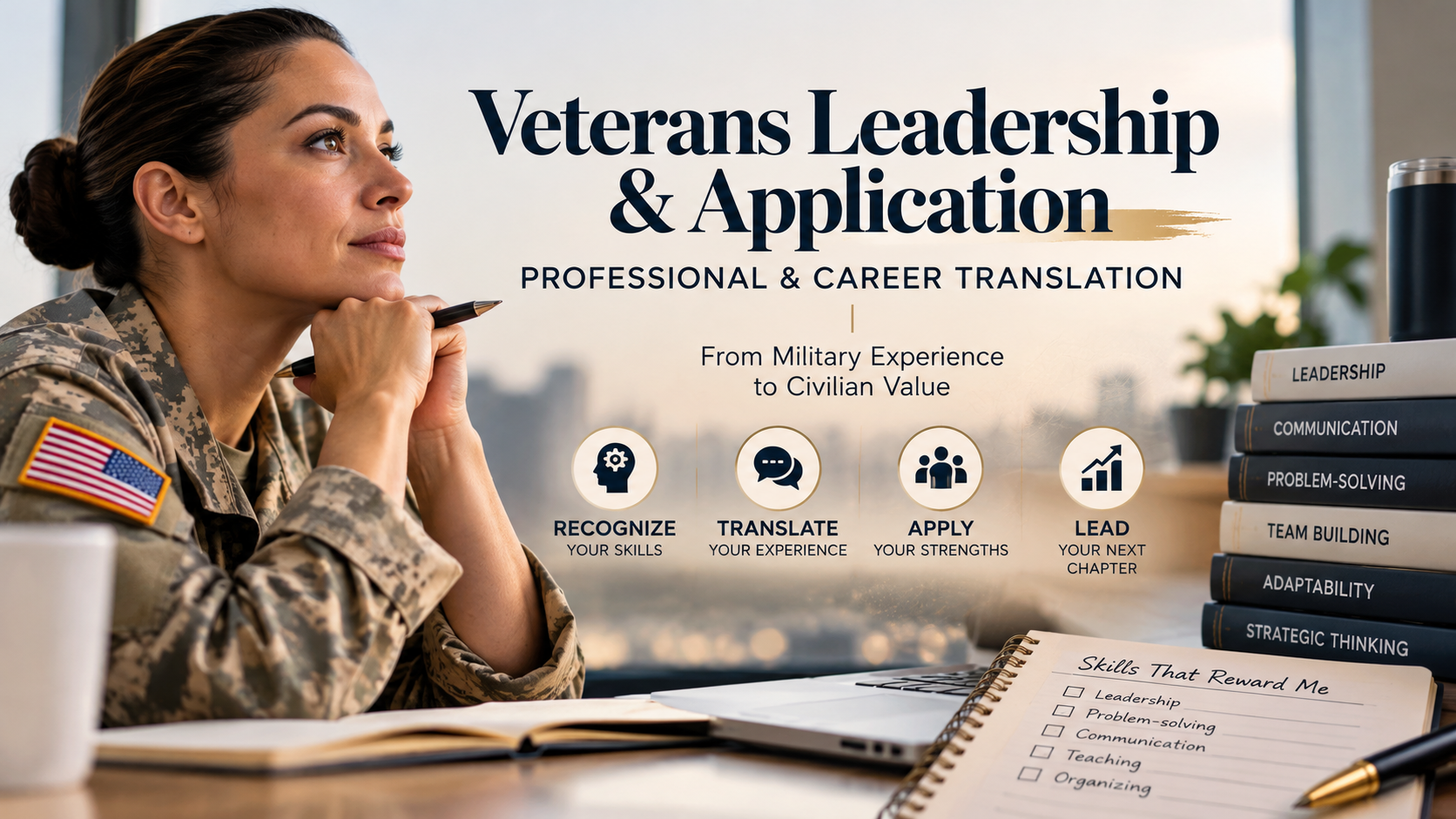

From Military Experience to Civilian Value
Veterans do not need to start over. They need to translate, apply, and communicate the skills they already have in a new environment.
Veterans Leadership & Skills Applications
1. Self-Leadership
- Self-awareness
- Accountabilit
- Decision-making
- Resilience
- Adaptability
- Goal setting
- Managing stress and uncertainty
Application: Turning military experience into personal leadership practices for civilian life and work.
2. Communication
- Clear verbal communication
- Briefing and presentation skills
- Active listening
- Written communication
- Difficult conversations
- Cross-cultural communication
- Storytelling
Application: Moving from “I know how to brief a mission” to “I can communicate strategy to an executive team.”
3. Team Leadership
- Building trust
- Delegation
- Conflict management
- Coaching others
- Accountability
- Psychological safety
- Leading diverse teams
Application: Translating squad/team leadership into supervisory and organizational leadership.
4. Strategic Thinking
- Mission → objective → strategy → execution
- Risk assessment
- Resource management
- Problem-solving
- Contingency planning
- Prioritization
- After-action reviews
Application: Using military planning habits to solve civilian organizational problems.
5. Project & Operations Management
- Planning
- Scheduling
- Logistics
- Process improvement
- Documentation
- Quality control
- Coordination across stakeholders
Application: Demonstrating that military operational experience can translate into project, program, and operations management.
6. Professional & Career Translation
This is where many veterans need the most help.
Instead of:
“I was a Platoon Sergeant.”
Translate the capability:
“I supervised personnel, coordinated resources, managed operational risk, trained team members, and executed time-sensitive objectives.”
The question becomes:
What did you do? → What skill did it require? → What business problem can that skill solve?
The Veterans Skills Translation Formula
Military Experience → Skill → Civilian Application → Evidence → Value
For example:
Military: Led a team during high-pressure operations
↓
Skill: Leadership + decision-making
↓
Civilian application: Supervising a multidisciplinary team
↓
Evidence: Team size, outcomes, projects completed
↓
Value: Improved execution, accountability, and team performance
7. Leadership Identity After Service
A powerful component would be helping veterans answer:
- Who am I outside my military role?
- What leadership qualities did service develop in me?
- Which skills remain valuable?
- Which behaviors need to be adapted?
- What kind of leader do I want to become?
- How do I communicate my value without relying exclusively on my military title?
- What does my next professional chapter look like?
Your Strategic Culture angle
This could fit very naturally into your Strategic Communication + Leadership + Storytelling work.
I would frame the program as:
Veterans Leadership & Skills Applications
Translate your experience. Apply your skills. Communicate your value. Lead your next chapter.
And potentially organize it into 4 phases:
RECOGNIZE → TRANSLATE → APPLY → LEAD
- Recognize what you actually learned through service.
- Translate military terminology into civilian language.
- Apply those capabilities to careers, entrepreneurship, leadership, and community.
- Lead with a new professional identity rather than feeling that you have to leave your experience behind.
This could become a workshop, workbook, coaching program, or veteran transition curriculum rather than simply a career-skills class.
Micro-Exercise: Find the Skills That Reward You
Veterans Leadership & Application: Professional & Career Translation
Time: 5–7 minutes
Ask yourself:
“What skills did I develop through my military experience that I genuinely enjoy using?”
Make three quick lists:
| Skill I Have | When I Use It | Why It Rewards Me |
| Leadership | Helping a team accomplish a goal | I enjoy seeing people succeed |
| Problem-solving | Finding solutions under pressure | I like figuring things out |
| Training | Teaching others | I enjoy helping people grow |
| Organization | Managing multiple priorities | I feel accomplished when things come together |
Step 1 — List 5 Skills
Don’t think about job titles. Think about what you actually do well.
Examples:
- Leading
- Teaching
- Organizing
- Planning
- Communicating
- Problem-solving
- Mentoring
- Analyzing
- Building relationships
- Making decisions
- Managing resources
- Adapting
- Creating
- Negotiating
Step 2 — Circle Your Top 3
Circle the three skills that give you a sense of accomplishment, purpose, energy, or satisfaction.
Step 3 — Complete This Sentence
“I feel most valuable when I am using my ability to __________ because __________.”
Step 4 — Apply It
Now ask:
“Where could I use these three skills in my next chapter?”
Think beyond a job. Consider:
Career | Leadership | Entrepreneurship | Consulting | Volunteering | Education | Community | Mentoring
Reflection
Your skills are not only things you can sell. Some are things that give you a sense of purpose.
The goal isn’t simply to find a job that matches your résumé.
The goal is to identify where your experience, abilities, interests, and sense of contribution intersect.
Until next time, take care and keep shining! 👋🏽✌🏽🐝
Yes, I use AI.
I believe in using the technology and tools available to me to support my creativity, organize ideas, explore possibilities, and bring concepts to life. AI is one of the tools in my toolbox—not a replacement for my experience, perspective, or voice.
Technology continues to evolve. So do we.