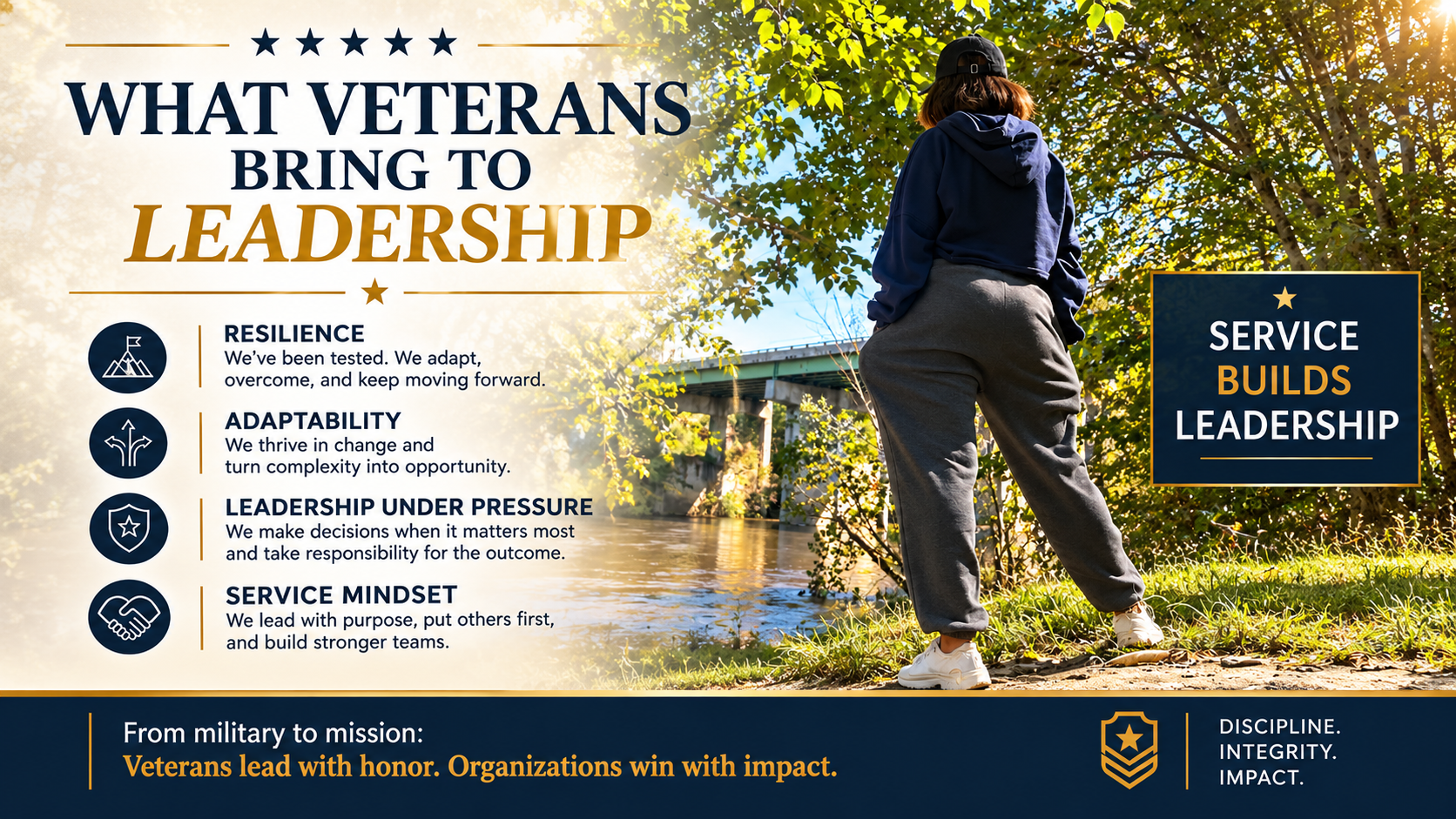

Veterans don’t just bring experience to leadership. They bring perspective earned through responsibility, uncertainty, teamwork, and service.
Military service can place people in environments where decisions matter, circumstances change quickly, resources are limited, and the ability to work together becomes essential.
These experiences can develop leadership competencies that extend far beyond military occupations.
Consider what happens when a service member must:
- Make decisions with incomplete information.
- Communicate clearly across different levels of responsibility.
- Adapt when the original plan no longer works.
- Coordinate people, resources, and competing priorities.
- Remain accountable for outcomes.
- Support a team while maintaining focus on the mission.
These are not exclusively military skills. They are also essential competencies in business, government, education, healthcare, technology, nonprofit organizations, and entrepreneurship.
Why veteran leadership matters in today’s workforce
Organizations face constant changes: technological transformation, workforce challenges, economic uncertainty, evolving customer expectations, and increasingly complex operational environments.
They need people who can think critically, communicate effectively, adapt to change, and help teams move forward.
Veterans can bring valuable experience in these areas.
According to the U.S. Bureau of Labor Statistics, approximately 17.26 million veterans were part of the civilian, noninstitutional population in 2025. Approximately 8.04 million were employed. The annual unemployment rate for veterans was 3.5%, compared with 4.2% for nonveterans.
These numbers demonstrate the significant presence of veterans in the American workforce. However, employment alone does not tell us whether their leadership experience is being fully recognized, understood, or utilized.
That is an important distinction.
Hiring veterans is one step. Recognizing, developing, and positioning their talent for leadership is another.
Five leadership competencies veterans can bring to organizations
1. Resilience through adversity
Resilience is more than enduring difficult circumstances. It involves learning, adjusting, recovering, and continuing to make informed decisions when challenges arise.
In an organization, this can translate into managing change, navigating uncertainty, and helping teams maintain perspective during difficult periods.
2. Adaptability in changing environments
Military operations require coordination, preparation, and the ability to adjust when circumstances change.
In civilian workplaces, adaptability means being willing to learn new technologies, reconsider strategies, respond to changing priorities, and find solutions without losing sight of organizational objectives.
3. Accountability and decision-making
Leadership requires ownership.
Military experience can provide opportunities to develop responsibility for people, resources, processes, and outcomes.
In business, accountability builds trust, strengthens communication, and supports consistent execution.
4. Teamwork and communication
A mission cannot depend on one individual.
Military environments emphasize coordination, communication, role clarity, and collaboration across teams.
These experiences can translate into stronger workplace relationships, cross-functional collaboration, and a better understanding of collective responsibility.
5. Mission-focused leadership and service
One of the most valuable perspectives veterans can bring is an understanding that leadership is not simply about personal achievement.
It is also about contributing to something larger than oneself.
Service-oriented leadership encourages people to consider the needs of their teams, their organizations, and the communities they serve.
The challenge: Translating military experience into civilian leadership
There is an important conversation we need to have.
Not every civilian employer understands military terminology, occupational specialties, rank structures, or the complexity of military responsibilities.
A veteran may have managed personnel, coordinated operations, trained teams, administered resources, or implemented procedures without describing those experiences using familiar corporate terminology.
This creates a translation gap.
For example:
- Mission planning can translate into strategic planning and project management.
- Personnel supervision can translate into people management and team development.
- Operational coordination can translate into program and operations management.
- Military instruction can translate into training, facilitation, and organizational development.
- Resource management can translate into budgeting and operational accountability.
The experience is valuable. The challenge is communicating its relevance.
Veterans should learn to articulate their competencies through measurable accomplishments, professional portfolios, civilian terminology, and continuous professional development.
Employers, in turn, should look beyond military job titles and ask what responsibilities, decisions, and results those experiences represent.
A reflection for veterans and organizations
For veterans:
Don’t limit your professional identity to the position you held in uniform.
Identify the problems you solved, the people you supported, the decisions you made, the resources you managed, and the results you helped achieve.
Your military experience is part of your professional story, not the limit of your professional potential.
For employers:
Don’t simply ask whether a veteran can perform a particular job.
Ask what leadership capabilities, operational knowledge, discipline, and perspective that person can contribute to your organization.
And create opportunities for veterans to grow into leadership positions.
Leadership is not about the uniform or the title.
It is about character, consistency, communication, accountability, and the ability to guide others through challenges.
Military service can provide meaningful opportunities to develop these qualities. Civilian professional development helps transform those experiences into new opportunities for influence and impact.
The skills developed through service do not expire when someone takes off the uniform.
They continue to create value in workplaces, communities, businesses, and future generations of leaders.
A question worth reflecting on:
Are organizations truly recognizing the leadership potential of veterans, or are they only recognizing the military experience listed on their résumés?
Leadership should not end with military service. It should evolve.
#VeteranLeadership #LeadershipDevelopment #Veterans #ProfessionalDevelopment #MilitaryTransition #WomenVeterans #Resilience #Adaptability #ServiceLeadership
Until next time, take care and keep shining! 👋🏽✌🏽🐝
Yes, I use AI.
I believe in using the technology and tools available to me to support my creativity, organize ideas, explore possibilities, and bring concepts to life. AI is one of the tools in my toolbox—not a replacement for my experience, perspective, or voice.
Technology continues to evolve. So do we.