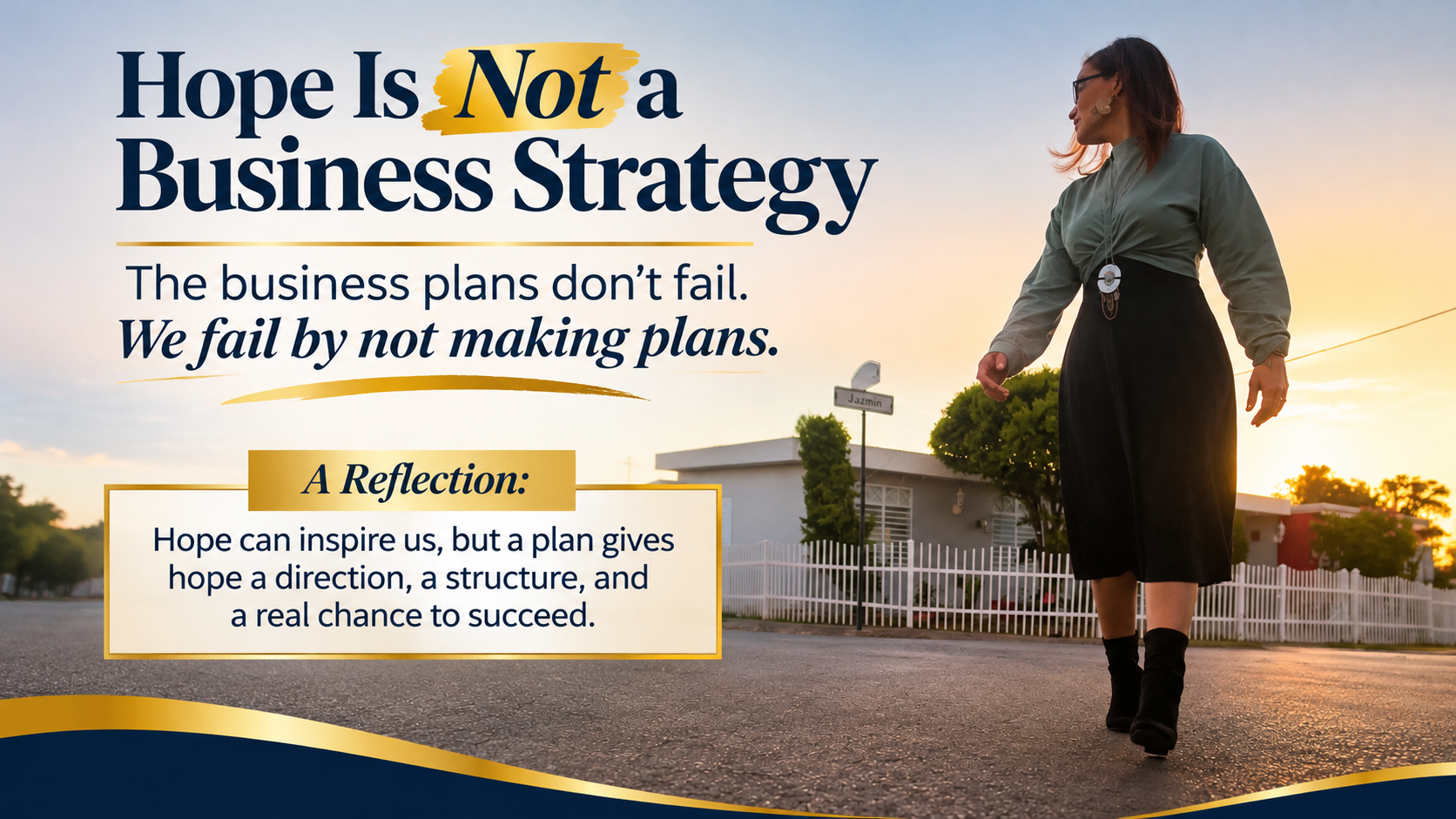

The business plan doesn’t fail because it exists. The failure often begins when we never create one, never execute it, or never adapt it.
There is an important difference between believing something is possible and developing a strategy to make it happen.
Hope is powerful. It gives us the courage to imagine a different future, believe in possibilities, and keep moving when circumstances become difficult.
But hope alone cannot manage resources, establish priorities, anticipate risks, identify opportunities, or measure progress.
That is where strategy comes in.
1. Hope gives us a vision. Planning gives us direction.
We often say:
- I hope to start a business.
- I hope to find a better career.
- I hope to become financially independent.
- I hope things will eventually work out.
- I hope someone recognizes my potential.
But what happens after we express those hopes?
Have we researched the opportunity? Identified the resources required? Evaluated the risks? Established a timeline? Determined what success looks like?
A vision without a plan remains an intention.
2. The problem isn’t always the plan. Sometimes, it’s the absence of one.
Think about entrepreneurship.
Someone may have an excellent business idea, a valuable product, and a genuine passion for serving customers.
Yet, passion doesn’t automatically create a profitable business.
Without market research, financial projections, customer identification, operational planning, marketing, and performance evaluation, even a promising idea can struggle.
The same principle applies to personal life.
We cannot expect professional growth without developing competencies. We cannot expect financial stability without understanding our finances. We cannot expect meaningful change while repeating the same decisions.
Expectations do not replace preparation.
3. Strategy requires accountability.
A business plan is not a guarantee of success. Markets change. Customers change. Resources become limited. Unexpected circumstances emerge.
A good strategy allows us to evaluate, adapt, and make informed decisions.
The same is true of personal development.
Sometimes we need to:
- Reassess our priorities.
- Recognize when an approach isn’t working.
- Develop new skills.
- Stop investing in opportunities that no longer serve our objectives.
- Accept responsibility for decisions within our control.
Planning isn’t about predicting everything. It’s about preparing to respond.
4. A plan is a commitment, not a prediction.
One of the biggest misconceptions about planning is that people believe a plan must be perfect before they begin.
It doesn’t.
A business plan is a working document. It should evolve as we learn more about the market, customers, resources, and competition.
Personal plans should evolve, too.
We need room to change direction without abandoning the destination.
There is a difference between changing your strategy and giving up on your vision.
5. Apply this to your personal life
Consider these examples:
| Hope | Strategy |
|---|---|
| I hope to have a successful career. | Identify competencies, opportunities, and professional milestones. |
| I hope to become financially independent. | Establish a budget, savings goals, and income strategy. |
| I hope to start a business. | Conduct market research, develop a business plan, and validate demand. |
| I hope to become a better leader. | Develop leadership competencies and practice accountability. |
| I hope to have a more fulfilling life. | Define your values, priorities, boundaries, and vision. |
The question isn’t whether you have dreams. The question is whether you have developed a path toward achieving them.
6. The reflection: What are you waiting for?
Sometimes we spend years waiting for the right moment, the right opportunity, the right resources, or the right circumstances.
But preparation is also a decision.
You don’t need to know every step. You need enough clarity to identify the next one.
Start with:
- A vision of what you want.
- An assessment of where you are.
- A strategy for getting there.
- Measurable objectives.
- A willingness to evaluate and adapt.
- Accountability for the decisions within your control.
One important qualification: Plans can fail, too. Poor assumptions, changing circumstances, and ineffective execution can undermine even a thoughtful strategy. But having no plan leaves us with fewer tools to recognize problems and respond.
A final thought
Hope is the beginning. Strategy is the bridge between what you imagine and what you work to accomplish.
Don’t confuse optimism with preparation. Don’t confuse being busy with making progress. And don’t confuse having an idea with having a strategy.
You cannot control every outcome, but you can take responsibility for how you prepare, decide, execute, and adapt.
The business plans don’t fail simply because they are plans. Sometimes, we fail to plan, fail to execute, or fail to adapt.
So, what are you hoping for that deserves a real strategy?
Until next time, take care and keep shining! 👋🏽✌🏽🐝
Yes, I use AI.
I believe in using the technology and tools available to me to support my creativity, organize ideas, explore possibilities, and bring concepts to life. AI is one of the tools in my toolbox—not a replacement for my experience, perspective, or voice.
Technology continues to evolve. So do we.