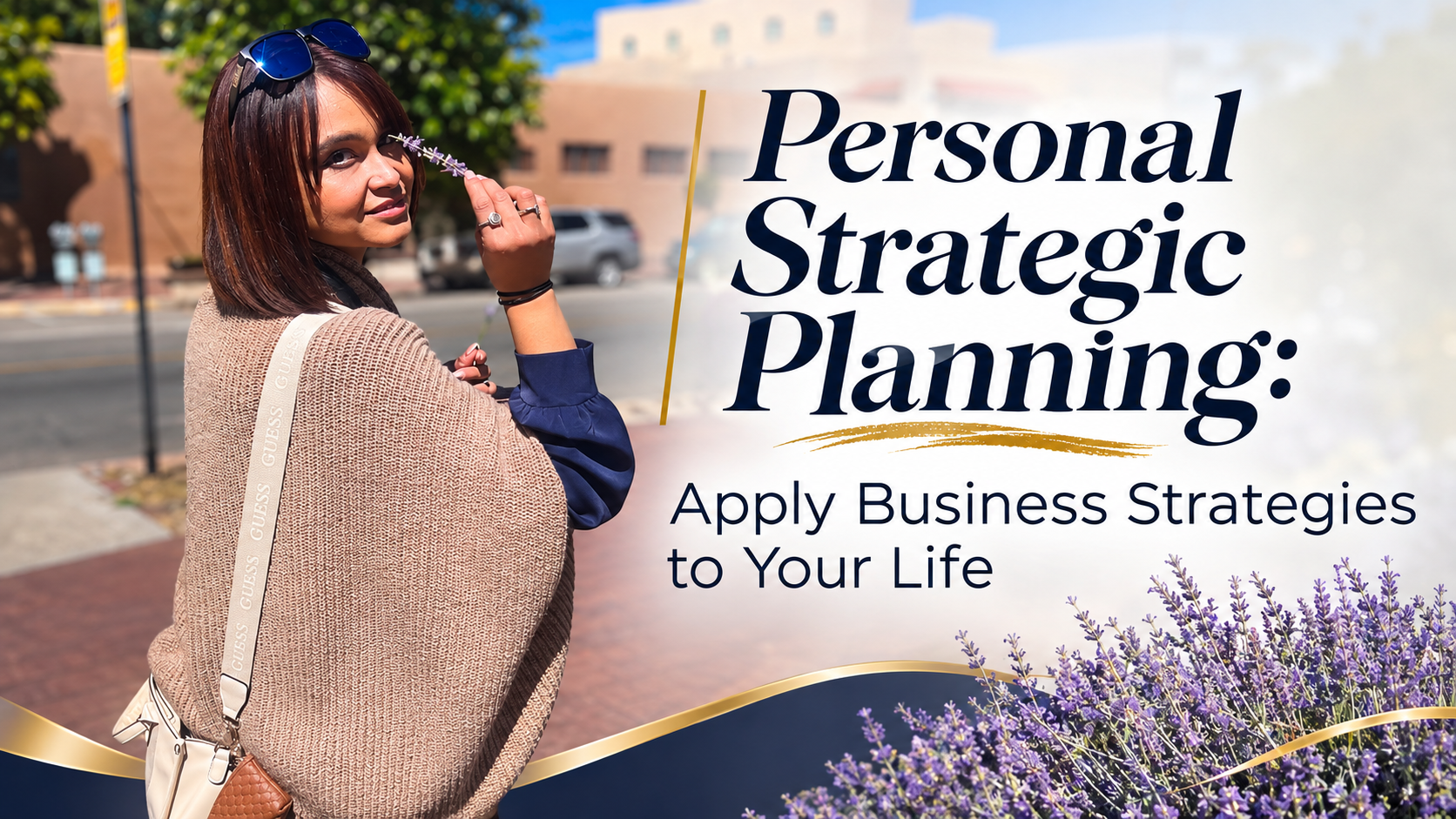

We often teach organizations to establish a vision, analyze their strengths, identify opportunities, manage risks, and measure performance. Yet, we don’t always apply those same principles to our personal lives.
I would like to approach this as a combination of Personal Strategic Planning, Leadership Development, Self-Advocacy, and Life Management.
The goal isn’t to turn your life into a business. It is to help you become more intentional about the decisions, opportunities, resources, and priorities that shape it.
Personal Strategic Planning
A framework for personal growth, direction, and intentional living
Why Your Alpha Mindset Needs Curiosity More Than Control | Mindfulness | Ahead App Blog
1. Start with reflection: Where am I today?
Before developing a strategy, organizations conduct an assessment. We should do the same personally.
Consider these six dimensions:
| Life dimension | Reflection question |
|---|---|
| Personal | Am I becoming the person I want to be? |
| Professional | Is my career aligned with my abilities and ambitions? |
| Financial | Are my financial decisions supporting my future? |
| Relationships | Are my relationships reciprocal and meaningful? |
| Intellectual | Am I learning, developing, and challenging myself? |
| Well-being | Am I creating a sustainable life? |
Reflection exercise:
Complete these sentences:
- I am proud of myself because…
- I have outgrown…
- I need to stop investing energy in…
- I want to experience more…
- I need to learn…
- I am postponing…
- My definition of success today is…
The important distinction: Your definition of success today might be different from what it was five years ago.
2. Apply business strategy tools to your personal life
Here are eight frameworks that can become part of your personal strategic planning process.
Strategy 1. SWOT Analysis — Understand your position
Self-awareness
SWOT helps you understand your internal resources and external circumstances.
S — Strengths
What do I bring to the table?
- Skills
- Experience
- Knowledge
- Character
- Relationships
W — Weaknesses
What needs development?
- Knowledge gaps
- Limiting habits
- Fear
- Lack of resources
- Inconsistency
O — Opportunities
What can I take advantage of?
- Education
- Networking
- New industries
- Mentorship
- New experiences
T — Threats
What could interfere?
- Financial uncertainty
- Market changes
- Time limitations
- External obligations
- Unplanned circumstances
Strategic reflection: How can I use my strengths to take advantage of opportunities while reducing weaknesses and threats?
Strategy 2. SMART Goals — Turn intentions into action
Goal setting
Instead of saying, “I want to become financially independent,” create a measurable objective.
SMART means:
- S — Specific: What exactly do I want?
- M — Measurable: How will I measure progress?
- A — Achievable: Is it realistic with my resources?
- R — Relevant: Does it support my priorities?
- T — Time-bound: When do I want to accomplish it?
Example:
| General intention | SMART objective |
|---|---|
| Improve my professional profile | Complete a professional portfolio by January 31, 2027 |
| Develop a business | Validate one business concept with 15 potential customers by February 28, 2027 |
| Improve financial stability | Establish a monthly budget and savings target by December 31, 2026 |
| Continue learning | Complete one relevant professional development course every month for six months |
The secret is to stop confusing activity with progress.
Strategy 3. PESTLE Analysis — Understand your environment
Environmental awareness
Businesses evaluate their external environment. Individuals should too.
| Factor | Personal application |
|---|---|
| Political | Government policies, benefits, employment regulations |
| Economic | Inflation, cost of living, income, job market |
| Social | Community, relationships, demographic changes |
| Technological | AI, digital skills, automation, emerging careers |
| Legal | Contracts, employment rights, legal obligations |
| Environmental | Where you live, accessibility, quality of life |
For example, if you are considering entrepreneurship, relocating, or changing professional directions, PESTLE helps you understand the environment before making a commitment.
Strategy 4. Personal OKRs — Measure what matters
Performance management
OKRs stands for Objectives and Key Results.
An objective describes what you want to accomplish. Key results measure whether you are getting there.
Example:
Objective: Build a more independent professional future.
Key results:
- Identify three viable professional or business opportunities.
- Conduct 15 market research interviews.
- Develop a portfolio demonstrating five professional competencies.
- Establish a realistic financial plan.
- Build three strategic professional relationships.
This framework is particularly useful because it connects your vision to measurable outcomes.
Strategy 5. Eisenhower Matrix — Manage your priorities
Time management
Not everything deserves your immediate attention.
DO
Urgent + Important
Deadlines, essential responsibilities, immediate problems.
SCHEDULE
Important + Not urgent
Education, relationships, planning, long-term goals.
DELEGATE
Urgent + Less important
Tasks others can handle.
ELIMINATE
Neither urgent nor important
Distractions, unnecessary commitments, activities that add no value.
A powerful question to ask yourself:
Am I spending my time building the life I want, or maintaining a life I no longer want?
Strategy 6. Risk Management — Prepare for uncertainty
Decision-making
Businesses don’t eliminate every risk. They identify, evaluate, and prepare for it.
Apply the same thinking to personal decisions.
| Risk | Possible strategy |
|---|---|
| Losing income | Develop alternative income streams |
| Career transition | Maintain a professional portfolio and network |
| Starting a business | Validate demand before investing heavily |
| Unexpected expenses | Establish an emergency fund |
| Missing opportunities | Develop a consistent professional development plan |
Ask yourself:
- What could go wrong?
- How likely is it?
- What would the consequences be?
- What can I do now to reduce the impact?
- What is my alternative plan?
Strategy 7. Personal Brand Positioning — Know your value
Identity and influence
Businesses develop positioning statements to communicate why customers should choose them.
Individuals can use the same principle to understand how they contribute to the world.
Consider:
- What do I know?
- What can I do exceptionally well?
- What problems can I solve?
- What experiences differentiate me?
- What do I want to be recognized for?
Your personal brand isn’t just your social media presence. It is the combination of your reputation, competencies, values, experiences, and the value you contribute.
Strategy 8. Cost-Benefit Analysis — Evaluate decisions
Strategic choices
Before making an important decision, evaluate what you gain and what you give up.
For example, accepting a new professional opportunity:
| Potential benefits | Potential costs |
|---|---|
| Higher income | Additional responsibilities |
| Professional growth | Time commitment |
| New connections | Relocation expenses |
| New experiences | Less personal flexibility |
Not every opportunity is a good opportunity.
Sometimes the most strategic decision is saying no.
3. Build your personal strategic plan
I recommend organizing your life around five strategic pillars.
Iqbal Stationery Mart | IQsmart.pk – School, Office, Art – IQ Smart.pk
1. Self-awareness
Understand your identity, values, strengths, limitations, and aspirations.
Reframe your life: the psychology that changes perspective instantly | by Ayna Utegalieva | Medium
2. Vision and direction
Define the life you want to build and the priorities that matter.
Стратегическое планирование в организации: что это, виды стратегий, цель
3. Strategic execution
Translate your goals into actions, milestones, and measurable results.
Naturen håller öppet när städerna stänger – Sveriges Natur
4. Adaptability
Evaluate circumstances, learn from experiences, and adjust your strategy.
5. Evaluation and growth
Review your progress, celebrate achievements, and identify what needs to change.
4. Your personal strategic planning worksheet
Let’s make this practical. You can use the following interactive exercise to begin developing your own strategy.
My Personal Strategy Canvas
PERSONAL DEVELOPMENT • STRATEGIC PLANNING • 2027
Start by answering honestly. There are no right or wrong answers.
1. Personal vision
What kind of life do I want to create over the next three years?
2. Professional direction
What kind of work, contribution, or professional identity do I want to develop?
3. Financial goals
What does financial stability and independence mean to me?
4. Relationships
Which relationships do I want to nurture, improve, or reconsider?
5. Personal growth
What skills, knowledge, and experiences do I want to acquire?
6. Well-being
What needs to change to create a more sustainable and fulfilling life?
SWOT: My starting position
My greatest strengths
My greatest challenges
My first strategic priorityPersonal developmentProfessional directionFinancial stabilityEntrepreneurshipRelationshipsWell-beingEducation and skills
My first SMART goal
Target completion date02/28/27
Develop my personal strategic plan
5. Establish a personal management rhythm
Businesses conduct weekly, monthly, quarterly, and annual reviews. You can establish a similar practice.
| Frequency | Personal strategy activity |
|---|---|
| Daily | Identify your three most important priorities |
| Weekly | Review accomplishments and unfinished tasks |
| Monthly | Evaluate goals, resources, and spending |
| Quarterly | Reassess your direction and adjust strategies |
| Annually | Revisit your vision, values, and long-term objectives |
6. An important reflection: You are the CEO of your life
I want to leave you with a different way of thinking about personal development.
A CEO doesn’t need to do everything. A CEO needs to understand the organization’s direction, allocate resources, make decisions, evaluate performance, and adapt to change.
You can apply those same leadership principles to yourself.
Consider these questions:
- Vision: Am I intentionally designing my future?
- Leadership: Am I taking responsibility for my decisions?
- Resources: Am I investing my time, energy, money, and knowledge wisely?
- Influence: Who and what influences my decisions?
- Execution: Are my daily actions aligned with my long-term objectives?
- Adaptability: Am I willing to change strategies when circumstances change?
A final thought
You don’t need a new life every time you reach a turning point. Sometimes, you need a new strategy for the life you already have.
An opportunity to develop this into something bigger
I also see potential for developing this concept into a structured personal development methodology connected to your work in leadership, strategic self-advocacy, and self-nurturing.
A possible framework:
PERSONAL STRATEGY 360°
A practical framework for leading your life with intention.
- Discover — Identity, values, and self-awareness.
- Assess — SWOT, resources, and environmental analysis.
- Envision — Personal vision and strategic direction.
- Strategize — SMART goals, OKRs, and risk management.
- Execute — Priorities, habits, and accountability.
- Evaluate — Performance, reflection, and continuous improvement.Potential application: Personal workbook, coaching program, workshops, and leadership development.
My recommendation: Let’s start with your personal strategic assessment, rather than immediately setting goals. First understand where you are, what you want, and what resources you have. Then we can build a realistic 12-month and three-year strategy.
That way, the strategy becomes a reflection of your actual life—not a list of expectations imposed on yourself.
Until next time, take care and keep shining! 👋🏽✌🏽🐝
Yes, I use AI.
I believe in using the technology and tools available to me to support my creativity, organize ideas, explore possibilities, and bring concepts to life. AI is one of the tools in my toolbox—not a replacement for my experience, perspective, or voice.
Technology continues to evolve. So do we.