
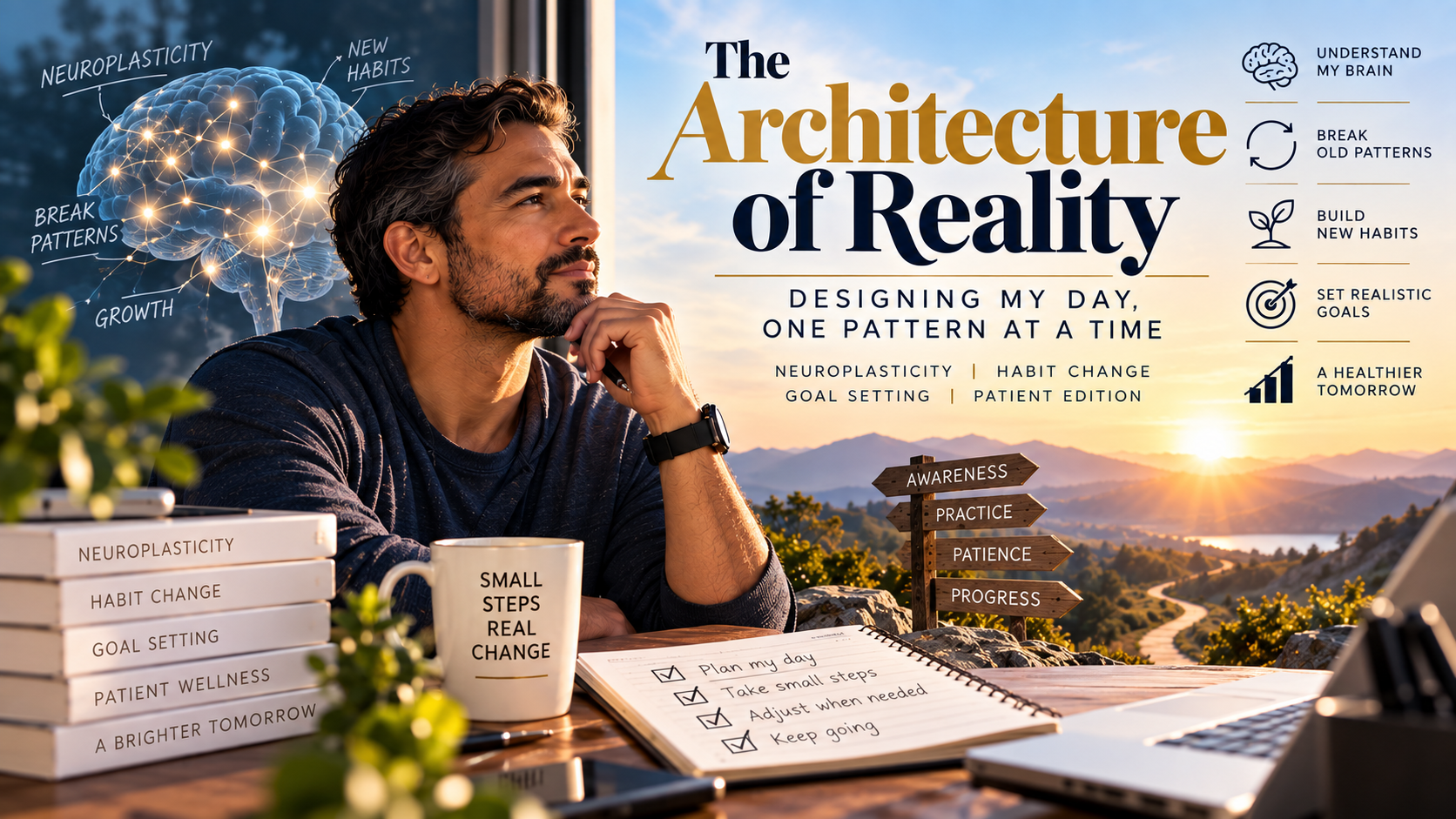

The Architecture of Reality: Designing My Day, One Pattern at a Time
I am the patient.
That changes the way I think about change.
When I hear people talk about neuroplasticity, breaking habits, changing patterns, and setting goals, I don’t hear a simple formula for becoming a better version of myself.
I hear a much more complicated question:
How do I build a life around the person I am today while continuing to work toward the person I want to become?
Because when I am dealing with symptoms, fatigue, pain, stress, neurological changes, emotional challenges, or an unpredictable day, I cannot always operate according to the plan I made yesterday.
Some days I have the capacity.
Some days I don’t.
And that has taught me something important:
My goal is not to control every part of my reality. My goal is to learn how to design within it.
My brain is part of the process
Neuroplasticity gives me an interesting way to think about change.
The nervous system can adapt in response to experience, learning, practice, and environmental demands.
But I don’t interpret that as:
“If I just think differently, I can fix myself.”
That would be an unfair burden to put on a patient.
Instead, I think about neuroplasticity as an invitation to practice.
If my brain and nervous system can adapt, then perhaps repeated experiences can help me develop new responses, skills, strategies, and routines.
That doesn’t replace medical treatment.
It doesn’t erase a diagnosis.
It doesn’t guarantee recovery.
But it gives me a reason to keep practicing.
I don’t have to erase the old pattern
One of the things I am learning is that changing a pattern isn’t necessarily the same as deleting it.
Some responses became familiar because they once served a purpose.
Stress taught me to react.
Fear taught me to anticipate.
Overwhelm taught me to shut down or step away.
Avoidance sometimes protected me from something that felt too difficult.
The problem is that a response that helped me survive one situation may not always help me move forward in another.
So instead of asking:
“How do I erase this?”
I can ask:
“What response do I want to practice next?”
That is a different question.
And for me, it feels much more compassionate.
I am learning to interrupt the pattern
Sometimes change happens in a very small space.
Something happens.
I notice my reaction.
I pause.
And instead of automatically following the familiar response, I ask:
What do I need right now?
That pause matters.
Maybe I need to breathe.
Maybe I need to step away.
Maybe I need to communicate a boundary.
Maybe I need to ask for help.
Maybe I need to break the task into smaller pieces.
Maybe I need to rest.
Maybe I need to continue.
The new behavior doesn’t have to be dramatic.
It just has to be intentional.
I am designing my day around reality
I used to think planning meant deciding everything I was going to accomplish.
Now I think planning can also mean understanding my capacity.
I can ask myself:
What can I realistically do today?
Not:
What should I be able to do?
That distinction matters.
Because “should” is based on an expectation.
Capacity is based on reality.
So I can create different versions of my day.
On a good-capacity day
I may be able to accomplish the full version of my plan.
On a limited-capacity day
I may need to reduce the task.
On a difficult day
My priority may be treatment, recovery, rest, or simply getting through what is necessary.
That doesn’t mean my goal disappeared.
It means the size of today’s step changed.
My goals need to become behaviors
I can say:
“I want to get healthier.”
But what does that actually mean tomorrow?
A goal becomes more useful when I translate it into something I can practice.
Instead of:
“I need to exercise more.”
I might say:
“If my health and treatment plan allow it, I will move for ten minutes after lunch.”
Instead of:
“I need to become more organized.”
I might say:
“At the beginning of my day, I will identify three priorities.”
Instead of:
“I need to stop getting overwhelmed.”
I might say:
“When I notice myself becoming overwhelmed, I will pause and identify the next manageable action.”
I am taking the large idea and turning it into something I can actually practice.
I can use an “If–Then” plan
One strategy I find useful is simple:
If this happens, then I will try this.
For example:
If I become overwhelmed, then I will pause before responding.
If I lose focus, then I will return to one task.
If I miss my planned activity, then I will look for the next opportunity instead of deciding that the entire day is lost.
If my capacity changes, then I will adjust the plan rather than criticize myself.
This changes the question from:
“Will I be able to follow my plan?”
to:
“What will I do when reality interrupts my plan?”
That is a much more realistic question for me as a patient.
My recovery does not have to look perfect
This may be one of the hardest lessons.
Progress isn’t always a straight line.
Some days I move forward.
Some days I repeat an old pattern.
Some days I discover something new about myself.
And some days the biggest accomplishment is recognizing that I need to stop.
I am learning not to interpret every difficult day as failure.
Instead, I can ask:
What did this day teach me?
What triggered me?
What helped?
What made something harder?
What made something easier?
What did I need that I didn’t have?
What can I change tomorrow?
That turns the experience into information.
And information can become strategy.
I am not trying to become a machine
There is a lot of productivity advice that assumes the human body will cooperate with the schedule.
As a patient, I know better.
My body is part of the equation.
My brain is part of the equation.
My energy is part of the equation.
My symptoms are part of the equation.
My environment is part of the equation.
My relationships and responsibilities are part of the equation.
So I don’t want a productivity system that ignores my humanity.
I want a system that helps me work with reality instead of constantly fighting it.
My one-week experiment
I don’t need to redesign my entire life.
I can start with one week.
I choose one goal.
Then I ask:
What behavior supports this goal?
When will I practice it?
What might interfere?
What will I do if that happens?
What is the smallest version of this behavior I can realistically complete?
And at the end of each day:
What did I learn?
That last question may be the most important one.
Because I am not simply trying to complete a checklist.
I am learning how I work.
I am building a new relationship with progress
Maybe progress isn’t:
“I finally fixed myself.”
Maybe progress is:
“I recognized the pattern.”
Then:
“I interrupted the pattern.”
Then:
“I practiced something different.”
Then:
“I tried again.”
Then:
“I adjusted when the plan didn’t work.”
That is still progress.
I don’t have to erase who I was.
I don’t have to pretend that difficult experiences never happened.
And I don’t have to force myself into someone else’s definition of recovery.
I can build new experiences on top of what I have already lived.
One decision.
One behavior.
One pause.
One boundary.
One practice.
One day at a time.
The architecture of my reality
I am learning that my reality isn’t something I can completely control.
But there are pieces of it I can participate in designing.
I can design my environment.
I can design routines that support me.
I can practice new responses.
I can set realistic goals.
I can learn from setbacks.
I can ask for help.
I can adjust.
And I can give myself permission to recognize that a smaller step is still a step.
I am not trying to build a perfect life.
I am learning how to build a life that works with the reality I am living.
That is my architecture of reality.
And I am designing it—
one day, one decision, and one pattern at a time.
Research & Resources
Research on neuroplasticity, habit formation, implementation intentions, goal setting, and neurological rehabilitation can help provide context for this reflection. These resources are educational rather than a substitute for individualized medical or rehabilitation care.
- National Institute of Neurological Disorders and Stroke (NINDS) — patient and caregiver education
- PubMed / PubMed Central — research on neuroplasticity, habits, goal-directed behavior, and behavior change
- Implementation intentions research — evidence surrounding “if–then” planning
- Neurological rehabilitation research — patient-centered goal setting, barriers, self-management, and incremental progress
Patient perspective disclaimer: This reflection represents a personal perspective on living with health-related challenges and thinking about behavior change. Neuroplasticity does not mean that a person can simply think, practice, or will themselves out of a medical condition. Individual recovery and treatment should be discussed with qualified healthcare professionals.

Until next time, take care and keep shining! 👋🏽✌🏽🐝
Yes, I use AI.
I believe in using the technology and tools available to me to support my creativity, organize ideas, explore possibilities, and bring concepts to life. AI is one of the tools in my toolbox—not a replacement for my experience, perspective, or voice.
Technology continues to evolve. So do we.