
Learning to grow without demanding perfection from yourself.
When the Fear of Getting It Wrong Gets in the Way of Becoming
Have you ever delayed starting something because you wanted to get it right?
Maybe you waited until you had more information, more confidence, a better plan, or the perfect moment. Perhaps you replayed a conversation in your head, questioned a decision you had already made, or focused so much on what went wrong that you overlooked everything you learned along the way.
Sometimes, what we call preparation is fear wearing a professional outfit.
And sometimes, what we call high standards is perfectionism quietly convincing us that our best is never enough.
But here is a reminder worth carrying with you:
A mistake is not the opposite of growth. It can be part of it.
The Difference Between Making a Mistake and Becoming One
There is a difference between acknowledging that you made a mistake and allowing that mistake to define who you are.
You can make a poor decision without being a failure. You can communicate something imperfectly and still be an effective communicator. You can experience a setback without losing your ability to succeed.
Yet, when our expectations become unrealistic, a single mistake can feel like evidence that we are not capable, qualified, or ready.
We begin to confuse performance with identity.
Instead of asking, “What can I learn from this experience?” we ask, “What is wrong with me?”
The first question creates room for reflection. The second can keep us trapped in self-criticism.
Growth requires us to recognize what happened without turning every disappointment into a judgment about our worth.
You are allowed to be a work in progress without treating yourself as a problem that needs to be fixed.
When Perfectionism Becomes a Barrier to Progress
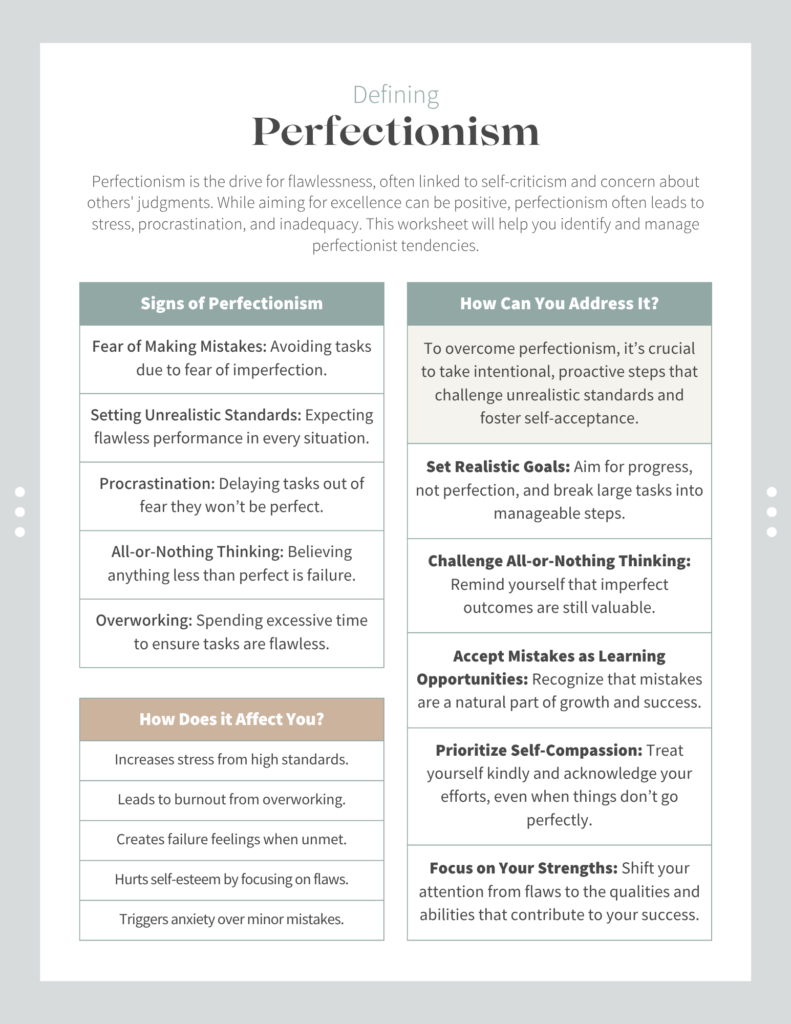
Perfectionism is not simply wanting to do something well. It can become a pattern of believing that anything less than flawless is unacceptable.
When this happens, we may:
- Avoid opportunities because we are afraid of failing.
- Procrastinate because we do not know how to begin perfectly.
- Overwork ourselves trying to eliminate every possible flaw.
- Focus on our weaknesses while overlooking our strengths.
- Experience unnecessary stress when reality does not meet our expectations.
The difficult part is that these behaviors can look like ambition, responsibility, or dedication from the outside.
We may receive recognition for our hard work while privately feeling exhausted by the pressure to prove ourselves.
We may accomplish a goal and immediately move the finish line.
We may learn something valuable from an experience but remain disappointed because the process was not as smooth as we imagined.
When perfection becomes the requirement for progress, progress becomes harder to achieve.
The goal is not to stop caring about the quality of our work. It is to stop making our self-worth dependent on flawless performance.
What If the Mistake Is Information, Not a Verdict?
Imagine approaching your next mistake as information.
What did the experience reveal about your preparation? Your expectations? Your communication? Your boundaries? Your assumptions?
Perhaps you discovered that you needed more information before making a decision. Perhaps you learned that a particular strategy was ineffective. Maybe you recognized that you were trying to manage something that was never entirely within your control.
These discoveries are useful.
They give you something to work with.
A mistake can help you identify a skill that needs development, a process that needs adjustment, or a belief that deserves to be questioned.
It can also teach you when to pause, when to ask for support, and when to give yourself permission to begin again.
However, learning from a mistake does not mean excusing harmful behavior or ignoring its consequences. Growth also requires accountability. Sometimes we need to apologize, repair trust, correct our actions, or accept the results of a decision.
Self-compassion and accountability can exist together.
You can acknowledge the impact of your actions without humiliating yourself. You can take responsibility without believing that you must punish yourself indefinitely.
The question becomes less about how to avoid ever getting something wrong and more about how to respond when something does not go as planned.
Give Yourself Permission to Be a Beginner Again
One of the uncomfortable parts of growth is that it often requires us to become beginners.
We must practice skills we have not mastered. We must ask questions. We must receive feedback. We must sometimes admit that what worked yesterday no longer works today.
For people who have built their identities around competence, independence, or being the person others rely on, this can be especially difficult.
We may feel pressure to know the answer before asking the question. We may interpret uncertainty as weakness. We may avoid trying something new because we do not want others to witness our learning process.
But competence is not the absence of uncertainty.
Competence includes knowing how to learn, how to adjust, and how to recognize when a different approach is needed.
You do not have to be an expert to take the first step.
You do not have to eliminate every fear before pursuing an opportunity.
And you do not have to wait until you feel completely ready to begin building the life, career, or project you envision.
Sometimes, confidence develops because you took action, observed the results, and learned that you could adapt.
You do not need to get everything right the first time. You need room to learn what the first attempt can teach you.
From Self-Criticism to Self-Advocacy
Self-advocacy begins with recognizing what you need to move forward.
Sometimes you need additional training. Sometimes you need clearer expectations. Sometimes you need rest, support, a different strategy, or a more realistic timeline.
And sometimes you need to challenge the internal voice that tells you every mistake is proof that you are falling behind.
Instead of automatically accepting that voice as the truth, pause and examine the evidence.
Would you judge someone else as harshly for making the same mistake?
Are you expecting yourself to perform perfectly in a situation where you are still learning?
Are you measuring your progress against someone else’s results without understanding their circumstances?
Are you holding yourself accountable for factors you could not control?
These questions can help you replace automatic self-criticism with a more balanced assessment.
Self-advocacy is not about convincing yourself that every decision was correct. It is about giving yourself a fair opportunity to understand the experience, identify what needs to change, and choose your next step.
You can learn without diminishing yourself.
You can improve without rejecting who you are today.
You can acknowledge your limitations without forgetting your capabilities.
That is a different relationship with growth: one built on honesty, responsibility, and respect for yourself.
A Reflection Exercise: What Is This Mistake Teaching Me?
Take a few minutes to reflect on an experience that did not go the way you expected. Choose something you feel comfortable examining.
You do not need to revisit your most painful experience to benefit from this exercise.
1. What happened?
Describe the situation using facts rather than judgments about yourself.
2. What did I expect to happen?
Identify the outcome you wanted and whether your expectations were realistic.
3. What am I telling myself about this experience?
Notice whether your thoughts are focused on what happened or making sweeping conclusions about who you are.
4. What can I learn from it?
Identify one lesson, skill, boundary, or adjustment that could help you in the future.
5. What is within my control now?
Consider whether you need to correct something, communicate with someone, seek support, change your approach, or let go of what you cannot change.
6. What would self-compassion look like in this situation?
Think about how you can treat yourself with understanding while still accepting responsibility for your actions.
7. What is one small step I can take next?
Choose an action that is realistic enough to begin, rather than waiting until you have a perfect plan.
Your Reminder for Today
You are not required to turn every mistake into a success story immediately.
Some experiences take time to understand. Some lessons become clearer only after you have moved forward. And sometimes, growth looks less like accomplishing something extraordinary and more like responding to yourself differently the next time things go wrong.
You can pause without giving up.
You can revise your plan without abandoning your vision.
You can admit that you were wrong without deciding that you are incapable.
And you can begin again without pretending the experience did not happen.
Progress is not always a straight line. It is an ongoing process of noticing, learning, adjusting, and choosing how to move forward.
So, the next time you make a mistake, consider changing the question.
Instead of asking, “How could I have let this happen?” ask yourself:
“Now that I know what I know, what can I do differently?”
Give yourself permission to answer honestly.
Give yourself permission to learn.
And give yourself permission to keep growing.
Your mistake may be part of your story, but it does not have to become the definition of who you are.
Continue Your Reflection
If you are ready to move from self-criticism toward greater clarity, begin by examining the standards you hold yourself to.
Download
Remember: you do not need to become perfect to make meaningful progress. You need the willingness to learn, the courage to take responsibility, and the self-compassion to keep moving forward.
Until next time, take care and keep shining! 👋🏽✌🏽🐝
Yes, I use AI.
I believe in using the technology and tools available to me to support my creativity, organize ideas, explore possibilities, and bring concepts to life. AI is one of the tools in my toolbox—not a replacement for my experience, perspective, or voice.
Technology continues to evolve. So do we.