
Introduction: Building a Fan Base Is About More Than Exposure
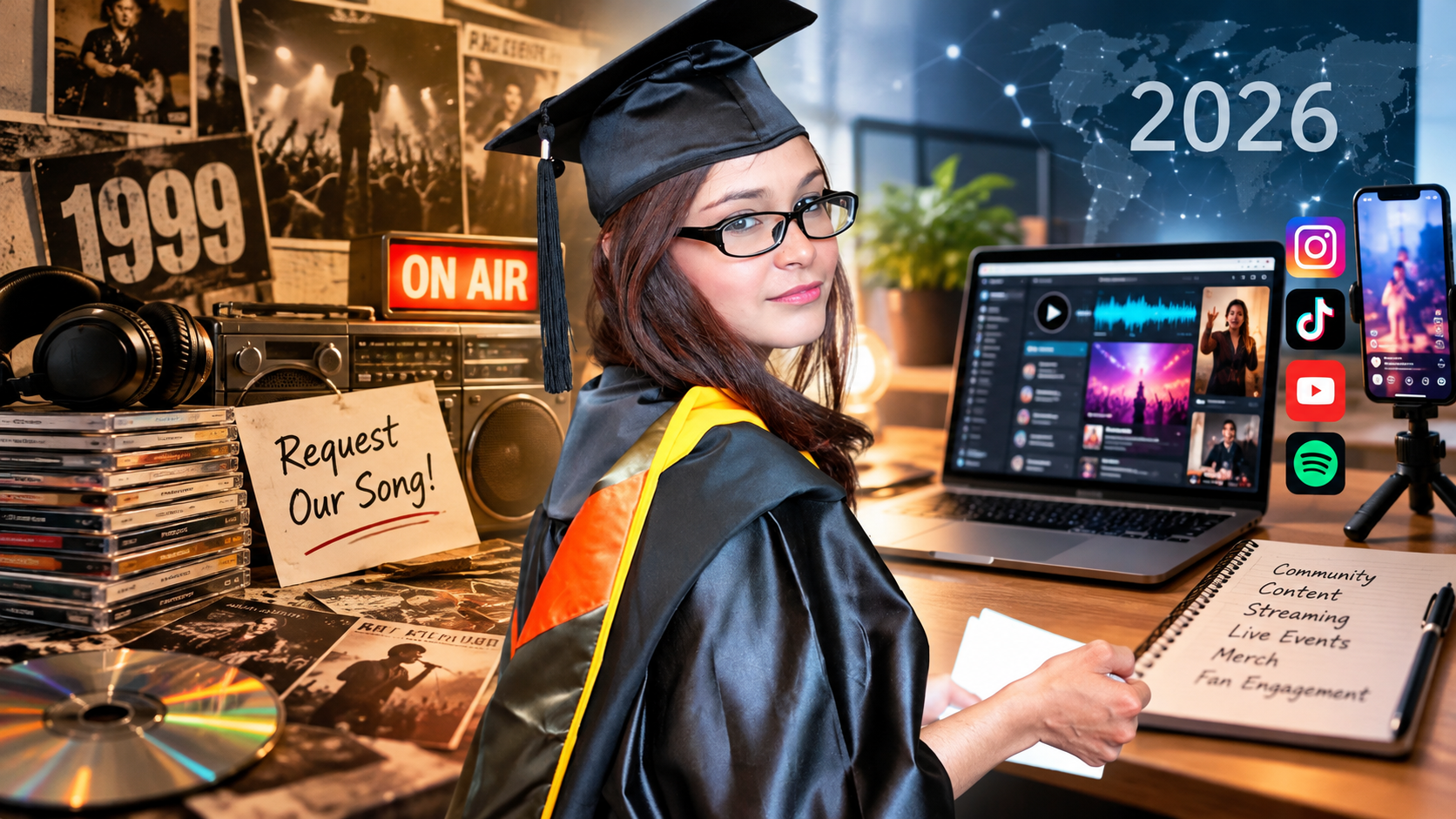
When I reflect on fan base development from 1999 to 2026, I see more than a technological transformation. I see a fundamental shift in the relationship between artists, audiences, media, and distribution.
In 1999, building a fan base required a combination of talent, relationships, access to media, and the ability to get music in front of people. An artist could have an incredible sound, but without radio airplay, physical distribution, a record label, a strong promoter, or the right industry connections, reaching a larger audience could be difficult.
Fan base development was not simply about promoting a song. It involved creating awareness, establishing credibility, mobilizing supporters, and encouraging people to participate in an artist’s growth.
Fans could join a street team, distribute flyers, attend performances, purchase physical albums, tell friends about new music, and call radio stations to request their favorite songs.
Today, technology has changed the barriers to entry. Artists can record music independently, distribute it internationally, create content from their homes, and communicate directly with audiences through social media. Streaming platforms and recommendation algorithms have expanded the possibilities for music discovery.
However, greater access to distribution has also created more competition for attention.
The biggest change is that building a fan base is no longer just about getting people to discover your work. It is about creating a relationship that gives them a reason to stay.
1. The Evolution of Fan Base Development: 1999–2026
1999–2003: Relationships, Radio, and Physical Distribution
At the end of the 1990s, the music industry relied heavily on established distribution networks, radio promotion, television, print media, live performances, record stores, and personal relationships.
For an emerging artist, visibility often depended on reaching the right people: radio personalities, music directors, promoters, journalists, record-label representatives, venue operators, and other industry professionals.
The fan base developer—whether that function was handled by a manager, publicist, promoter, street-team coordinator, or dedicated fan-club organizer—helped connect the artist’s work with potential supporters.
A campaign might include:
- Recruiting street teams to distribute promotional materials.
- Encouraging fans to request songs on local radio stations.
- Organizing listening parties and promotional appearances.
- Building fan clubs and maintaining mailing lists.
- Promoting concerts and appearances.
- Encouraging word-of-mouth recommendations.
- Developing relationships with local media and retail outlets.
This was also a period of disruption. Napster launched in 1999, challenging traditional distribution and changing public expectations about how music could be accessed. Digital file sharing exposed the limitations of a business model built around physical sales and established distribution channels.
The transition had begun: music could travel digitally even when the artist’s traditional promotional infrastructure had not caught up.
2003–2009: The Rise of Online Artist Identity
As online platforms developed, artists gained new opportunities to establish a presence outside traditional media.
MySpace, YouTube, artist websites, blogs, and online communities helped musicians share music, videos, photographs, announcements, and personal stories with audiences beyond their immediate geographic markets.
An artist’s online profile became more than a digital business card. It could function as a promotional hub, a discovery tool, and a place where listeners could interact with the artist’s identity.
The fan base developer now had to think about both the physical and digital worlds.
Instead of relying exclusively on a local street team, artists could mobilize supporters through online communities. Instead of waiting for a media outlet to publish an interview, they could share their own updates. Instead of distributing only promotional flyers, they could circulate links to music and videos.
The principle remained familiar: build relationships and encourage participation. The environment had changed.
2010–2019: Social Media and Streaming
The expansion of Facebook, Instagram, Twitter, YouTube, and music-streaming services changed how artists maintained visibility between releases.
Fans could follow an artist’s career continuously. They could comment on posts, share videos, attend livestreams, discover collaborations, and listen to music without purchasing an entire physical album.
Distribution became increasingly digital, and audience data became more important to marketing decisions.
Artists and their teams could begin examining which content attracted attention, which audiences responded, and how promotional activity related to listening behavior.
But a new challenge emerged: a follower was not necessarily a loyal fan.
A person might follow an artist without listening to the music. A video might receive thousands of views without producing repeat listeners. A song might attract attention without building a lasting audience.
The industry increasingly needed strategies that went beyond accumulating followers.
2020–2026: Algorithms, Creator Culture, and Global Fan Communities
Today, artists can use short-form video, streaming platforms, livestreams, podcasts, online communities, email marketing, direct-to-fan commerce, and digital advertising to reach audiences.
A song can become popular through a short video before its creator has an established audience. An older recording can find new listeners through a film, a television series, a viral trend, or a creator’s recommendation.
In its 2025 year-end report, Luminate highlighted the continued role of short-form video in music discovery, including renewed interest in catalog recordings. Its research also examines the progression from casual listeners to engaged fans and superfans.
Yet the same environment creates challenges. Algorithms change, platform visibility fluctuates, content competes for attention, and viral exposure does not necessarily translate into a sustainable career.
The modern fan base developer must coordinate discovery, storytelling, community participation, distribution, and long-term engagement.
The goal is not simply to become visible. It is to create a meaningful reason for audiences to return.
2. What Has Changed—and What Has Not?
The tools have changed significantly, but the underlying principles of human connection remain remarkably consistent.
| Fan development in 1999 | Fan development in 2026 |
| Radio exposure and music television | Streaming discovery, social media, and recommendation algorithms |
| CDs, cassettes, and physical retail | Streaming, digital releases, and continued physical merchandise |
| Street teams and promotional flyers | Digital street teams, creator partnerships, and fan ambassadors |
| Mailing lists and fan clubs | Email communities, memberships, and online fan groups |
| Local and regional market development | International audience development |
| Record-label distribution networks | Independent distribution and multiple digital channels |
| Radio spins, record sales, and concert attendance | Reach, repeat listening, engagement, conversions, and revenue |
| Direct relationships with DJs and promoters | Relationships with media, platform teams, creators, communities, and fans |
One distinction is particularly important: distribution and fan development are not the same thing.
Distribution makes music available. Marketing helps people discover it. Fan development gives people reasons to return, participate, advocate, and support the artist.
An artist can reach a million people and still have a weak fan base. Another artist can have a smaller audience that attends every show, purchases merchandise, recommends the music, and supports new releases.
The second artist may have built a more sustainable community.
3. The Role of the Fan Base Developer
Fan base development is a function, not merely a social media task.
Depending on the organization, the work may be shared among artist managers, publicists, radio promoters, digital marketers, community managers, tour promoters, fan-club coordinators, and audience development specialists.
The fan base developer helps align these activities around a central question:
How do we move people from discovering an artist to developing an ongoing relationship with that artist?
Historically, this could mean coordinating street teams, radio requests, local appearances, fan clubs, and promotional events.
Today, the same function may include coordinating digital campaigns, creating opportunities for fan participation, developing email communities, analyzing engagement data, supporting streaming releases, and identifying appropriate revenue opportunities.
The most effective strategy connects these activities rather than treating them as separate promotional tasks.
A social media post should support the larger campaign. A radio promotion should reach an appropriate audience. A live event should strengthen the relationship. An email campaign should provide value rather than simply repeat advertisements.
Fan development is the work of creating continuity between these experiences.
4. Radio Requests: When Fans Helped Move a Song
One of the most important strategies in the 1990s was encouraging fans to request songs on the radio.
Radio requests illustrate how fan participation could become part of an artist’s promotional strategy.
Imagine an independent artist releasing a new single in 1999.
The artist’s team might distribute promotional materials, arrange local appearances, build relationships with DJs, and organize a street team. Fans who discovered the song could call radio stations and ask to hear it.
A coordinated campaign might unfold in five stages:
- Discovery: Fans hear the song at a concert, through a friend, on a recording, or during a promotional appearance.
- Participation: Fans call the station to request the song.
- Signal of interest: The station receives genuine requests that may indicate local audience demand.
- Programming consideration: DJs or program directors may consider playing the song, depending on station policies, format, audience research, and other programming decisions.
- Further exposure: If the song receives airplay, additional listeners may discover it, creating opportunities for more requests, record purchases, and concert attendance.
Radio requests did not guarantee airplay. Stations retained control over their programming, and professional promotion, audience research, record-label relationships, and other commercial considerations could influence decisions.
Nevertheless, the strategy demonstrates an important principle: fans were not merely consuming entertainment. They were participating in the process of making it visible.
From radio requests to digital participation
The same idea continues today, although the channels have expanded.
Fans can share an artist’s release, create videos using a song, recommend music to friends, attend live performances, participate in online communities, and follow an artist’s official release announcements.
Digital participation can help create awareness, but each platform has its own rules and algorithms. Sharing content does not guarantee that a song will receive additional exposure, just as requesting a song did not guarantee radio airplay.
The enduring principle is organized, genuine participation.
A fan base developer creates opportunities for supporters to participate in ways that feel authentic, useful, and rewarding.
5. What the Data Tells Us About Music Discovery Today
Historical comparisons are useful, but modern strategies also need evidence.
Research from Edison Research, SSRS, Luminate, and IFPI illustrates how people discover music, how they engage with artists, and how distribution has changed.
Radio still has a place in music discovery
Edison Research’s 2024 Music Discovery Report found that among Americans aged 12 and older who considered keeping up with music important:
- 82% used friends and family as a music discovery source.
- 70% used YouTube.
- 50% used AM/FM radio.
- 48% of Americans aged 12 and older used Spotify to learn about music, compared with 25% in 2016.
These findings show that music discovery is not limited to a single channel. Personal recommendations, radio, video, and streaming can all play a role.
The radio-request strategy therefore remains a useful historical lesson, even though today’s promotional mix is broader. Radio can still contribute to discovery, while digital channels create additional ways to introduce music and maintain audience relationships.
Source: Edison Research / SSRS — The Music Discovery Report.
Streaming has transformed music distribution
According to IFPI’s Global Music Report 2026, global recorded music revenues reached $31.7 billion in 2025, representing 6.4% growth. Streaming accounted for 69.6% of global recorded music revenue, while paid subscription streaming alone accounted for 52.4%.
These figures describe industry revenue, not the percentage of listeners who are fans of a particular artist. They demonstrate, however, how central digital distribution has become to the recorded music business.
For artists, streaming availability is important, but availability alone is not a complete fan development strategy. Artists still need to help listeners discover their work, return to it, and build a relationship with the wider catalog and the artist’s identity.
Source: IFPI — Global Music Report 2026.
Superfans demonstrate the value of deeper engagement
Luminate’s 2025 Year-End Music Report estimated that 20% of U.S. music listeners qualified as superfans under its definition, which considers engagement with artists through five or more types of activity.
This is important because fandom is not a single behavior.
One listener may stream a song. Another may stream the song, follow the artist, attend concerts, purchase merchandise, participate in a community, and recommend the artist to friends.
The second listener has a broader relationship with the artist.
The objective is not to force every listener to become a superfan. It is to understand the different levels of engagement and create appropriate opportunities for people to deepen their involvement.
Source: Luminate — 2025 Year-End Music Report.
Taken together, these findings support a practical conclusion: successful fan development requires an understanding of both discovery and continued engagement.
6. From Attention to Connection: A Fan Engagement Framework
Not every person who encounters an artist will become a dedicated fan. A useful strategy recognizes different levels of engagement and provides opportunities for the relationship to grow.
Level 1: Discovery
Someone hears a song on the radio, sees a video, discovers a playlist, attends a performance, or receives a recommendation from a friend.
Strategic objective: Make a strong first impression and help the right audience discover the artist.
Possible measures include reach, impressions, video views, new listeners, and referral sources.
Level 2: Interest
The listener explores more music, watches another video, follows the artist, or searches for information.
Strategic objective: Give the audience a reason to explore further.
Possible measures include profile visits, catalog listening, repeat views, and new followers.
Level 3: Engagement
The listener returns regularly, shares content, joins an email list, attends an event, or participates in a community.
Strategic objective: Build familiarity and meaningful interaction.
Possible measures include returning listeners, email sign-ups, event attendance, and repeat engagement.
Level 4: Advocacy
The fan recommends the artist, creates content, introduces friends to the music, or participates in promotional activities.
Strategic objective: Make it easy for enthusiastic supporters to share their genuine appreciation.
Possible measures include referrals, fan-created content, recommendations, and participation in official campaigns.
Level 5: Sustained support
The fan purchases tickets, merchandise, memberships, or other offerings, and continues to support the artist over time.
Strategic objective: Build a sustainable relationship that benefits both the artist and the fan.
Possible measures include repeat purchases, membership retention, concert attendance, and revenue per engaged supporter.
These levels are a practical planning framework, not a claim that every fan follows the same sequence. Someone might attend a concert before following an artist online, for example.
The important point is to develop a strategy that supports the entire relationship rather than focusing exclusively on the first encounter.
7. Fan Base Development Strategies: Then Versus Now
The most useful approach is not to abandon traditional methods, but to adapt their underlying principles to the current environment.
Strategy 1: Build a community, not just a contact list
Then: Fan clubs, mailing lists, street teams, and local events helped create a sense of belonging.
Now: Email communities, online fan groups, memberships, livestreams, and in-person events can provide ongoing opportunities for connection.
The objective is to give fans a reason to participate between releases, rather than contacting them only when the artist needs to promote something.
Strategy 2: Coordinate radio and digital promotion
Then: Street teams, radio requests, promotional appearances, and DJ relationships supported a release campaign.
Now: Artists can combine legitimate radio outreach with streaming links, short-form videos, interviews, email announcements, and fan participation.
Each channel should serve a defined purpose. Radio promotion should follow station policies, streaming campaigns should follow platform rules, and fan requests should reflect genuine interest.
Strategy 3: Develop a consistent artist identity
Then: Press photographs, interviews, album artwork, public appearances, and promotional materials helped establish an artist’s image.
Now: Social media, websites, videos, interviews, livestreams, and digital artwork provide additional ways to communicate that identity.
Consistency matters. The audience should be able to recognize the artist’s values, personality, musical direction, and story across different channels.
Strategy 4: Use audience data to guide decisions
Then: Teams relied on radio reports, record sales, concert attendance, mailing lists, and feedback from promoters and fans.
Now: Artists can examine streaming dashboards, audience demographics where available, engagement metrics, website traffic, email performance, ticket sales, and merchandise results.
Data should inform decisions rather than replace judgment. A large number of views may indicate visibility, but it does not necessarily demonstrate loyalty or commercial success.
Strategy 5: Create opportunities for fan participation
Then: Fans requested songs, distributed flyers, brought friends to shows, joined fan clubs, and attended promotional events.
Now: Fans can share official releases, create original content, attend listening parties, participate in online discussions, and recommend music to their networks.
Participation should be voluntary and authentic. The objective is to support a community, not manipulate metrics.
Strategy 6: Connect fandom to sustainable revenue
Then: Record sales, concert tickets, merchandise, and fan-club activities supported the artist’s business.
Now: Artists can combine streaming income with live performances, physical products, merchandise, memberships, licensing, partnerships, and other appropriate revenue opportunities.
Not every channel will be suitable for every artist. The right mix depends on the audience, the artist’s business model, and the resources available.
8. A Practical Fan Development Campaign for Today’s Artist
Consider an independent artist preparing to release a new single.
A coordinated campaign can combine the relationship-building principles of 1999 with the tools available in 2026.
Phase 1: Prepare the foundation
Identify the intended audience, define the artist’s positioning, prepare promotional materials, establish the release schedule, and identify relevant radio stations, media outlets, creators, and community partners.
Recruit a small group of genuinely engaged supporters who are interested in helping share the release.
Phase 2: Coordinate the release
Make the single available through the appropriate distribution channels. Share the story behind the music, publish supporting content, and provide fans with clear information about where they can listen.
If radio is relevant to the genre and market, submit the track through appropriate channels and follow each station’s submission requirements.
Phase 3: Activate genuine fan participation
Invite fans to share the release, recommend it to friends, attend a listening event, or create original content. Provide approved artwork and links to make participation easy.
Where appropriate, invite fans to request the song at stations that accept listener requests. Do not use automated calls, fabricated requests, artificial streams, or misleading engagement tactics.
Phase 4: Measure the results
Review the campaign against its objectives. Track relevant indicators such as:
- Radio submissions and confirmed airplay.
- New and returning listeners.
- Streaming activity and catalog exploration.
- Website visits and email sign-ups.
- Audience engagement and fan-created content.
- Event attendance, merchandise sales, and other revenue.
Phase 5: Continue the relationship
After the initial release, share additional stories, highlight live performances, communicate upcoming projects, and provide opportunities for fans to remain involved.
The campaign should not end when the promotional budget runs out or the first wave of attention declines.
The long-term goal is to create a relationship that can support future releases, performances, collaborations, and business opportunities.
9. Storytelling, Public Relations, and the Human Side of Fandom
Technology can distribute a message, but it cannot guarantee that the message will matter to someone.
This is where storytelling and strategic communication become essential.
Fans may connect with an artist because of the music, but they may also be drawn to the artist’s background, cultural identity, creative process, values, humor, community involvement, or personal journey.
A thoughtful fan development strategy considers five questions:
Identity: What does the artist represent beyond the product?
Audience: Who is most likely to connect with the work, and why?
Value: What emotional, cultural, social, or entertainment value does the artist provide?
Participation: How can fans become active participants rather than passive consumers?
Continuity: What gives fans a reason to remain engaged between releases, projects, and events?
These questions connect public relations, branding, audience research, and community development.
The objective is not to manufacture a relationship. It is to communicate consistently, deliver meaningful experiences, and create opportunities for genuine participation.
10. What Has the Evolution of Fan Development Taught Us?
Reflecting on the period from 1999 to 2026 reveals five lessons.
First, access is not the same as success. Digital distribution makes music available to a global audience, but availability does not guarantee discovery, loyalty, or revenue.
Second, relationships still matter. The tools have changed, but recommendations, community participation, and trust continue to influence how people discover and support artists.
Third, fans can contribute to promotion. From radio requests and street teams to digital sharing and fan-created content, audience participation has long been part of music marketing.
Fourth, data must be connected to strategy. Reach, engagement, repeat listening, audience retention, and revenue measure different aspects of performance. A successful campaign needs to know what it is trying to achieve.
Fifth, sustainable fandom requires continuity. An artist needs more than a successful release or viral moment. Long-term development involves consistent communication, meaningful experiences, and opportunities for fans to remain connected.
Conclusion: From Radio Requests to Digital Communities
The evolution of fan base development since 1999 reveals an important paradox. Technology has made it easier to reach people around the world, but reaching people is not the same as making them feel connected.
In 1999, the challenge was often securing access to distribution, radio exposure, and established promotional networks. In 2026, the challenge is navigating a vast number of channels while creating a distinctive, credible, and lasting relationship with an audience.
The tools have changed from CDs, radio promotion, and physical fan clubs to streaming, social media, creator platforms, digital communities, and audience analytics.
Yet the foundation remains the same: people support what resonates with them, what they trust, and what they feel connected to.
The fan base developer of the past helped mobilize people to make a song heard. The fan base developer of today must coordinate discovery, participation, distribution, storytelling, and long-term engagement.
The future of fan base development belongs not simply to those who can attract attention, but to those who can turn attention into connection, connection into community, and community into sustained support.
The strategic question is no longer just, “How do we get more fans?”
It is:
How do we create an experience that gives the right people a reason to discover us, stay with us, participate in our journey, and help us grow?
That is the difference between building an audience and developing a fan community.
References and Further Reading
- Edison Research / SSRS. The Music Discovery Report (2024). Read the report summary.
- IFPI. Global Music Report 2026: Global Recorded Music Revenues Grow 6.4% (2026). Read the report announcement.
- Luminate. 2025 Year-End Music Report (2026). Explore the report.
- Pew Research Center. The State of Music Online: Ten Years After Napster (2009). Read the research.
Note: Industry revenue, music discovery, and superfan statistics measure different things and should not be compared as if they were the same metric. Fan development strategies should be adapted to the artist, genre, audience, and market.

Until next time, take care and keep shining! 👋🏽✌🏽🐝
Yes, I use AI.
I believe in using the technology and tools available to me to support my creativity, organize ideas, explore possibilities, and bring concepts to life. AI is one of the tools in my toolbox—not a replacement for my experience, perspective, or voice.
Technology continues to evolve. So do we.