
Product Design 101 for New Civilians
One of the biggest adjustments when entering civilian life is realizing that your experience is not automatically a product.
You may have spent years learning how to execute a mission, solve problems, manage people, operate systems, meet deadlines, and adapt under pressure.
Then you enter the civilian marketplace and someone asks:
“What do you do?”
Suddenly, the answer isn’t as simple.
You know what you have done.
But do you know how to design it into value?
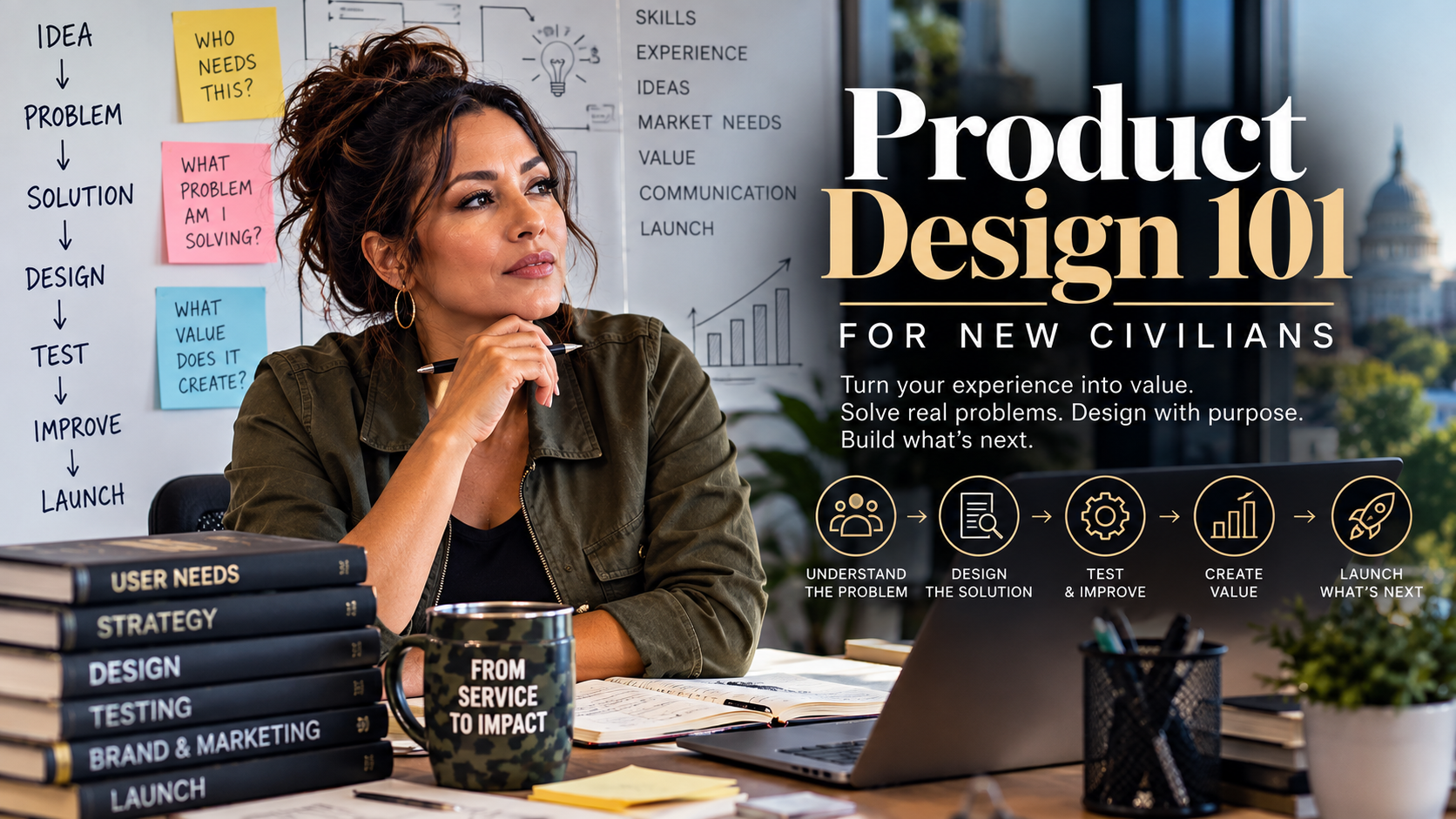
Start With the Problem
Product design begins with a problem.
Before asking:
“What can I sell?”
Ask:
“What problem can I solve?”
Your experience is the raw material.
Your job is to translate that experience into something another person can understand and use.
For example:
Experience:
“I managed logistics and coordinated teams.”
Product-thinking translation:
“I help organizations coordinate people, resources, and timelines so projects move forward with fewer operational gaps.”
The second statement begins to communicate value.
Design for the User
A common mistake is designing something around what you know instead of what the user actually needs.
The customer doesn’t necessarily care about your entire history.
They care about their problem.
Ask:
- Who is the user?
- What are they struggling with?
- What are they trying to accomplish?
- What frustrates them?
- What would make the process easier?
- What outcome are they willing to invest in?
This is where your communication skills become part of product design.
If people don’t understand the value, the product has a communication problem—even if the product itself is good.
Don’t Build the Perfect Product First
New civilians sometimes feel pressure to have everything figured out immediately.
You don’t.
Design a small version.
Test it.
Listen.
Improve it.
A workshop can become a course.
A consulting session can become a program.
A checklist can become a template.
A recurring problem can become a service.
Product design is iterative.
You don’t need certainty before you begin.
You need enough clarity to test an idea.
Your Experience Is Intellectual Capital
Think about the problems you have repeatedly solved.
What do people ask you for help with?
What did you learn the hard way?
What systems do you understand?
What skills did you develop that other people are still trying to acquire?
Those answers may contain the foundation of your next:
career → service → product → business.
The transition isn’t necessarily about leaving everything behind.
Sometimes it’s about learning how to repackage what you already know for a new audience.
The New Civilian Product Design Exercise
Choose one experience from your previous career.
Complete these sentences:
I know how to:
I learned this through:
The problem this could help solve is:
The person or organization experiencing this problem is:
The outcome they want is:
I could turn this knowledge into:
Then ask one final question:
“Would someone actually use this?”
That question changes everything.
Because product design isn’t about proving that you are talented.
It is about creating something useful.
Your experience is the starting point.
Your ability to translate it into value is the design.
And the marketplace becomes the testing ground.
Until next time, take care and keep shining! 👋🏽✌🏽🐝
Yes, I use AI.
I believe in using the technology and tools available to me to support my creativity, organize ideas, explore possibilities, and bring concepts to life. AI is one of the tools in my toolbox—not a replacement for my experience, perspective, or voice.
Technology continues to evolve. So do we.