
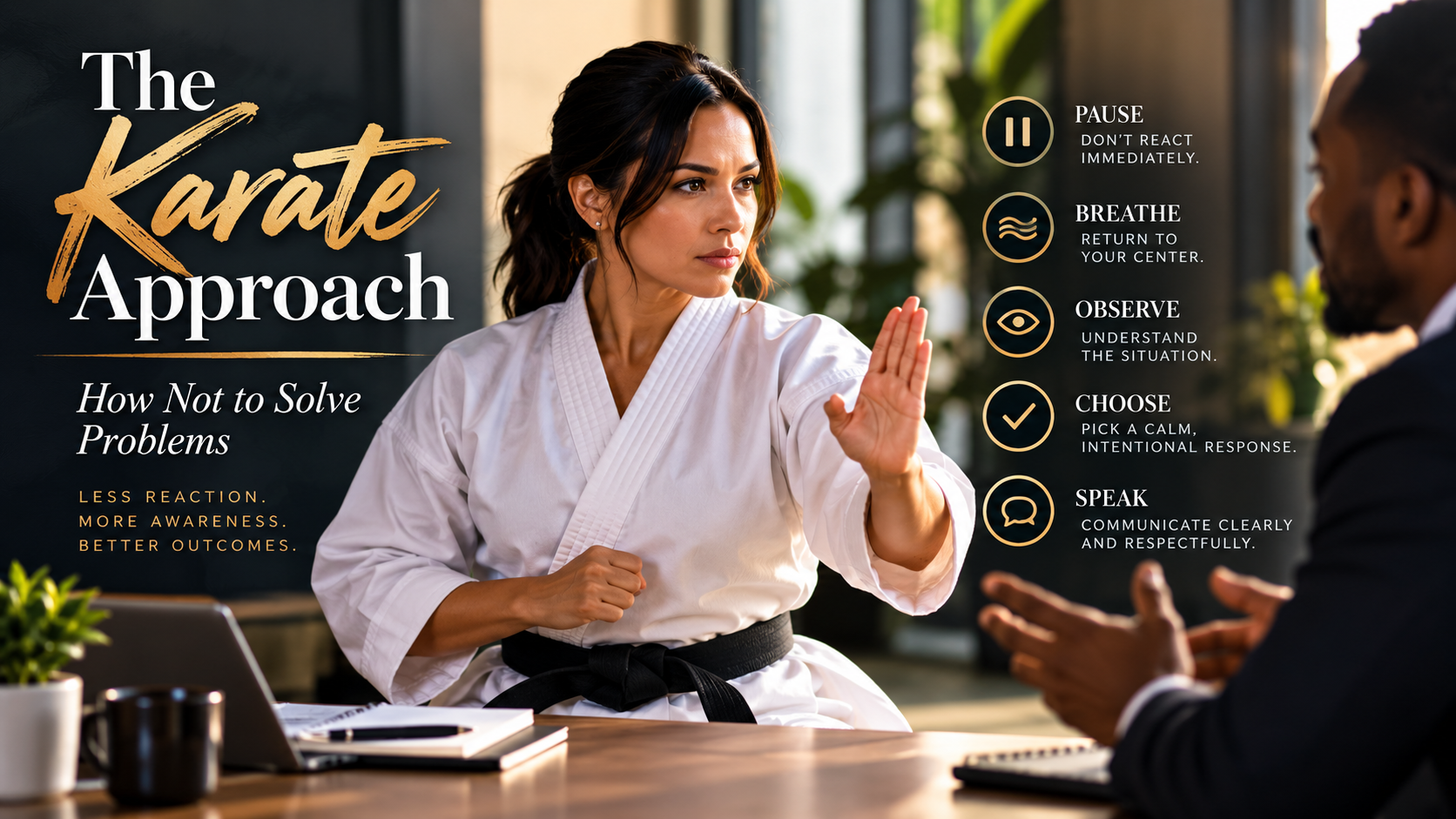

Karate teaches discipline, awareness, timing, control, and restraint.
Those principles can also teach us something important about communication:
Not every difficult conversation needs more force.
When we feel challenged, misunderstood, disrespected, or pressured, our instinct may be to defend ourselves immediately. We may raise our voice, interrupt, over-explain, withdraw, or try to prove that we are right.
But sometimes the harder we push, the harder the other person pushes back.
A karate approach to communication is not about winning the fight.
It is about recognizing the situation before deciding how to respond.
What Karate Can Teach Us About Difficult Conversations
1. Don’t react before you observe.
Before responding, notice what is actually happening.
What was said?
What was your interpretation?
What is the other person asking for?
What part of the situation is within your control?
Observation creates space between the stimulus and your response.
2. Don’t use more force than necessary.
A difficult conversation does not automatically require a difficult response.
You don’t have to match someone’s volume.
You don’t have to match their defensiveness.
You don’t have to prove your authority.
Sometimes the most effective response is calm, direct, and brief.
Less force can create more control.
3. Don’t fight every movement.
Not every comment requires correction.
Not every disagreement requires resolution immediately.
Not every misunderstanding needs a ten-minute explanation.
Ask yourself:
“Does this need to be addressed, or do I simply feel the need to respond?”
That distinction can change the entire conversation.
4. Control your center.
In martial arts, balance matters.
Communication works the same way.
When you lose your emotional center, the conversation can quickly become about your reaction instead of the original issue.
Before responding, return to your center:
Breathe.
Pause.
Observe.
Choose.
Respond.
5. Know when to step away.
Stepping away isn’t always avoidance.
Sometimes it is strategy.
If the conversation has become disrespectful, circular, emotionally overwhelming, or unproductive, you can create space.
A professional boundary might sound like:
“I want to continue this conversation, but I think we need a pause. Let’s come back to this when we can have a productive conversation.”
You don’t have to finish every conversation while you’re activated.
The Problem With Trying to “Win”
Sometimes we enter difficult conversations with an invisible objective:
I need them to understand me.
I need them to admit they’re wrong.
I need to prove my point.
I need to make them see my perspective.
But communication isn’t always about winning.
Sometimes the goal is simply to:
- clarify the issue
- protect the relationship
- establish a boundary
- communicate a decision
- gather information
- reduce unnecessary escalation
- determine the next step
The question becomes:
“What outcome am I actually trying to create?”
That question can change how you enter the conversation.
Micro Exercise: The 5-Second Reset
Before responding to a difficult person or situation, take five seconds.
1. STOP
Don’t respond immediately.
2. BREATHE
Take one slow breath.
3. OBSERVE
Ask:
What is actually happening right now?
4. CHOOSE
Ask:
What response supports the outcome I want?
5. SPEAK
Use one clear sentence.
Try:
“Let me make sure I understand what you’re asking.”
or
“I hear your concern. Let me respond to the specific issue.”
or
“I don’t agree, but I’m willing to discuss the issue.”
or
“I’m not comfortable continuing this conversation in this tone.”
Then stop.
You don’t always need a second paragraph.
Practice: Don’t Solve the Person
One of the most useful communication shifts is recognizing that you are responsible for your response, not for controlling another person’s behavior.
You cannot make someone listen.
You cannot make someone agree.
You cannot make someone regulate their emotions.
You can control how you enter the conversation, what you communicate, what boundaries you establish, and when you decide to disengage.
Reflection Question
Think about a difficult conversation you’ve had recently.
Ask yourself:
Did I respond to the problem—or did I react to the person?
Then ask:
What would change if I approached the same situation with more awareness, less force, and better timing?
That is the karate approach.
Not every problem needs to be fought.
Some problems need to be observed, redirected, contained, or walked away from.
Learn. Practice. Apply. Influence.
Learn how your communication changes under pressure.
Practice creating space before responding.
Apply one clear boundary or intentional response.
Influence the conversation without trying to control the other person.
Your strength isn’t always in how hard you respond. Sometimes it is in knowing when not to.

Until next time, take care and keep shining! 👋🏽✌🏽🐝
Yes, I use AI.
I believe in using the technology and tools available to me to support my creativity, organize ideas, explore possibilities, and bring concepts to life. AI is one of the tools in my toolbox—not a replacement for my experience, perspective, or voice.
Technology continues to evolve. So do we.