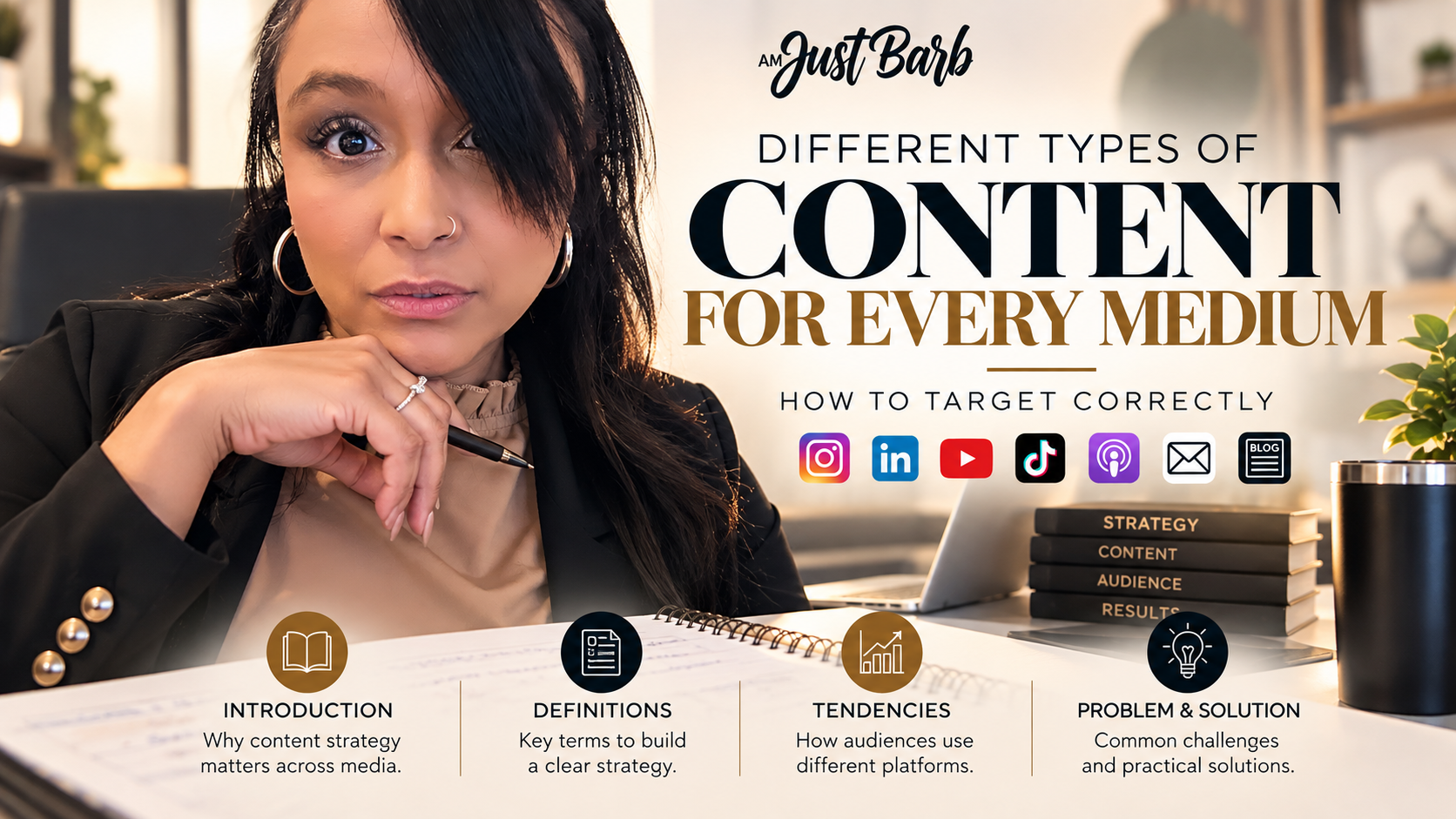

A strategic guide to content formats, audience tendencies, and problem-solving through media.
1. Introduction
Creating content is not simply about deciding what to say. It is about understanding who needs the message, where they are most likely to encounter it, how they prefer to consume information, and what action they might take afterward.
A blog article, Instagram Reel, LinkedIn post, YouTube video, podcast, and email newsletter may communicate the same core idea, but each medium offers a different experience.
For example, if you want to teach entrepreneurs how to turn an idea into a product, you might publish an in-depth blog post explaining the process, create a short video highlighting common mistakes, share a LinkedIn post about project planning, and offer a downloadable product brief template.
The message remains consistent, but the format, depth, delivery, and call to action change.
The strategic principle: Start with the audience’s problem, choose the medium that best supports the intended experience, and develop content that helps the audience move toward a meaningful outcome.
2. Definitions: Content, medium, channel, and audience targeting
Understanding these terms helps you build a content strategy instead of publishing material without a clear purpose.
- Content: The information, story, message, or experience you create. Examples include tutorials, interviews, educational articles, testimonials, and promotional videos.
- Medium: The form through which a message is communicated, such as written text, audio, video, photography, or interactive media.
- Channel: The platform or distribution method used to reach people, such as Instagram, LinkedIn, YouTube, a website, email, or a podcast directory.
- Audience targeting: The process of identifying and reaching people based on relevant characteristics, needs, interests, behaviors, and intent.
- Content format: The structure used to present the message, such as a carousel, Reel, long-form article, infographic, webinar, or downloadable guide.
- Content objective: The intended result, such as increasing awareness, educating an audience, building trust, generating leads, or encouraging a purchase.
- Call to action (CTA): The next step you want the audience to take, such as reading an article, downloading a template, booking a consultation, or subscribing to a newsletter.
How these elements work together
Consider a business owner who wants to promote a Product Brief Template.
Audience
Entrepreneurs and creative professionals with ideas they want to develop.
Content and medium
An educational article explaining how to define a product and plan a project.
Channel and format
A website blog, promoted through a LinkedIn post and an Instagram carousel.
Objective and CTA
Encourage qualified readers to visit the skills page and explore the template.
The same subject can appear across several channels, but each version should serve the audience’s needs in that environment.
3. Tendencies: How audiences use different media
Audience tendencies are patterns, not universal rules. People use platforms differently depending on their age, interests, accessibility needs, profession, habits, and the situation in which they encounter content.
Pew Research Center’s 2025 survey of 5,022 U.S. adults found that 84% used YouTube, 71% used Facebook, 50% used Instagram, and 37% used TikTok. Usage also varied substantially by age: 80% of adults ages 18–29 used Instagram, compared with 19% of adults ages 65 and older.
These figures help demonstrate why audience research matters. They describe reported platform use, not guaranteed engagement or purchase intent.
Common content tendencies by medium
| Medium or channel | Typical audience need | Useful content formats | Strategic purpose |
| Website and blog | Detailed answers, explanations, research | Articles, guides, case studies, resource pages | Search visibility and education |
| Visual discovery, concise lessons, identity | Reels, carousels, Stories, photos | Awareness and engagement | |
| Professional insights and career or business relevance | Expert posts, documents, case studies, articles | Credibility and professional relationships | |
| YouTube | Demonstrations, explanations, deeper learning | Tutorials, interviews, Shorts | Education and discoverability |
| Podcast | Listening while commuting, working, or exercising | Interviews, discussions, solo episodes | Relationships and thought leadership |
| Email newsletter | Relevant updates and curated resources | Educational emails, newsletters, offers | Retention and conversion |
| Webinar or workshop | Interaction, guided learning, practical application | Live demonstrations, Q&A, training | Trust and lead development |
These are strategic starting points rather than fixed platform rules. Validate them against your own audience and analytics.
Research reinforces the value of matching formats to objectives. The Content Marketing Institute’s 2025 B2B research, based on 980 B2B marketers, found that 76% used video, 75% used case studies or customer stories, and 69% used long-form articles. Respondents rated video as their most effective content type, at 58%, followed by case studies at 53%.
What this means: Do not select a medium solely because it is popular. Choose it because it helps your audience consume the information, experience the value, and take the next step.
4. Problem and solution: Match the content to the audience’s need
Effective targeting starts by identifying the gap between what the audience currently experiences and what they want to achieve.
A person who does not know your brand needs a different message from someone who already trusts you and is considering purchasing your service.
Use this framework to align content with audience needs.
Stage 1 · Awareness
The problem: “I know something isn’t working, but I don’t know how to fix it.”
Content solution: Introduce the problem, explain why it matters, and help people recognize their situation.
Formats: short videos, introductory blog posts, infographics, relatable stories.
Stage 2 · Consideration
The problem: “I understand the problem, but I don’t know which solution is right for me.”
Content solution: Explain methods, compare options, share research, and demonstrate how a solution works.
Formats: tutorials, comparison guides, webinars, case studies, educational carousels.
Stage 3 · Decision
The problem: “I want to take action, but I need confidence in my next step.”
Content solution: Make the offer clear, explain the process, answer objections, and provide a straightforward next step.
Formats: service pages, demonstrations, testimonials, FAQs, consultations, product briefs.
Stage 4 · Retention
The problem: “I’ve started, but I need help applying what I’ve learned.”
Content solution: Support implementation, encourage progress, answer questions, and help people achieve the intended outcome.
Formats: email sequences, checklists, resource libraries, workshops, follow-up guides.
This is a practical model of the audience journey, not a rigid sequence. People can enter at different stages, revisit earlier questions, or make decisions without encountering every type of content.
A real-world example: Promoting a Product Brief Template
Imagine your audience consists of entrepreneurs and creatives who have ideas but struggle to organize them.
| Audience challenge | Content response | Intended action |
| They have an idea but feel overwhelmed. | Reflective post about turning ideas into plans. | Recognize the problem. |
| They do not understand product briefs. | Educational blog post explaining the essential elements. | Learn the process. |
| They want a practical starting point. | Product Brief Template and quick exercise. | Explore or use the resource. |
| They need help developing the project. | Coaching, consulting, or project planning resources. | Explore professional support. |
Each piece of content has a purpose. Together, they form a connected strategy rather than a collection of unrelated posts.
5. Audience targeting: How to reach the right people
Targeting is not simply selecting an age group, location, or social media platform. It requires understanding the people you want to reach and why your message matters to them.
Five targeting dimensions
- Demographics: Relevant characteristics such as age range, professional stage, or location when appropriate.
- Psychographics: Interests, motivations, values, aspirations, and attitudes.
- Behavior: Actions such as searching for a solution, watching tutorials, downloading resources, or engaging with particular topics.
- Needs and intent: The problem someone is trying to solve and how ready they are to act.
- Context: Where, when, and under what circumstances the person is likely to consume your content.
For example, “entrepreneurs ages 25–45” is a broad audience description.
“First-time entrepreneurs who have a business idea but need help defining their offer, planning a launch, and controlling costs” is more useful for content strategy because it identifies the challenge your content can address.
Quick targeting exercise
Choose the audience you want to reach and answer these questions.
Who are you targeting?
Entrepreneurs and small-business owners
Artists and creative professionals
Coaches and consultants
Veterans transitioning to civilian careers
What problem are they experiencing?
I have an idea but don’t know where to start.
What do they need from your content?
Understand the problem
Learn a practical process
Compare solutions
Make a purchase or book a service
Where will you reach them?
Website or blog
YouTube
Email newsletter
What should they do next?
Read an educational article
Download or use a template
Subscribe to a newsletter
Book a consultation
Create my targeting strategy
6. Current tendencies and what the data means for your strategy
The research suggests several practical lessons.
Short-form and visual content can support discovery. HubSpot’s 2025 marketing report identified short-form video and images among the most-used formats reported by marketers. However, format popularity alone does not establish that a format will perform best for your particular audience.
Educational and evidence-based content can support credibility. The Content Marketing Institute found that high-performing B2B marketers emphasized audience understanding (82%), content quality (77%), and industry expertise (70%).
Clear objectives matter. In that same study, 42% of marketers whose content strategies were moderately effective or worse cited unclear goals as a reason. This reinforces the need to define the intended outcome before choosing the content format.
Repurposing can extend the value of research. One well-researched blog article can become a video script, carousel, newsletter, checklist, and discussion prompt. Each version should be adapted to its channel rather than copied identically everywhere.
7. A practical content planning model
Use the following sequence before producing your next campaign.
01
Research
Identify audience needs, questions, search behavior, and relevant evidence.
02
Define
Choose one audience, one problem, and one primary content objective.
03
Match
Select the medium and format that best support the audience’s need.
04
Adapt
Adjust the message, length, visuals, and CTA for each distribution channel.
05
Measure
Review relevant indicators such as qualified visits, saves, downloads, leads, and conversions.
06
Improve
Use results and audience feedback to refine the next content cycle.
8. Problem-solving: What to do when your content isn’t working
| Problem | Possible cause | Recommended response |
| High views but few clicks | The CTA or offer may be unclear. | Make the next step specific and relevant. |
| Low engagement | The topic, hook, or format may not resonate. | Test a more specific audience problem and opening. |
| Website traffic without conversions | The page may not match the promise made in the post. | Align the landing page with the audience’s intent. |
| Many likes but few leads | Engagement may not reflect purchase intent. | Measure qualified visits, inquiries, and conversions. |
| Inconsistent publishing | The process may require too much effort. | Create a realistic calendar and repurpose core content. |
| Lots of content but unclear results | Objectives or measurement may be missing. | Assign one primary objective and KPI to each campaign. |
Avoid assuming that one disappointing post proves a topic or platform does not work. Check the audience, distribution, timing, creative execution, and conversion path before deciding what to change.
9. Quick exercise: Build a one-week content campaign
Choose one problem your audience wants to solve. Then use one core topic to create a sequence of content.
For example, your core topic could be: How to turn an idea into a defined product.
- Monday — Awareness: Publish a short reflection about why ideas remain unfinished.
- Tuesday — Education: Share five questions to ask before developing a product.
- Wednesday — Deeper learning: Publish a blog article with research, examples, and a planning process.
- Thursday — Practical application: Share a Product Brief Template or quick exercise.
- Friday — Conversion: Explain how your professional services or resources help people take the next step.
Measure the results against the goal you selected. If the goal is awareness, examine reach and relevant engagement. If it is resource adoption, examine qualified visits and downloads. If it is client acquisition, examine inquiries and booked consultations.
The objective is not to publish everywhere. It is to create a connected experience that helps the right people move from a question to a solution.
Conclusion: Target with intention, create with purpose
Effective content strategy combines audience research, appropriate media selection, clear messaging, useful solutions, and measurable objectives.
You do not need to be present on every platform or create every content format. You need to understand your audience well enough to decide what to create, where to distribute it, and what meaningful outcome you want to support.
Start with the problem. Choose the medium. Deliver value. Measure the response. Improve the next iteration.
The right content does more than attract attention. It helps the right audience take the right next step.
Explore strategic communication, business development, and professional resources at iamjustbarb.com/skills.
Research and further reading
- Pew Research Center — Social Media Use in 2025.
- Content Marketing Institute — B2B Content Marketing Benchmarks, Budgets, and Trends: Outlook for 2025.
- HubSpot — 2025 State of Marketing & Trends Report.
Research note: Survey results describe the populations and periods studied. Marketing benchmarks are useful reference points, not guarantees of performance for an individual brand.
Until next time, take care and keep shining! 👋🏽✌🏽🐝
Yes, I use AI.
I believe in using the technology and tools available to me to support my creativity, organize ideas, explore possibilities, and bring concepts to life. AI is one of the tools in my toolbox—not a replacement for my experience, perspective, or voice.
Technology continues to evolve. So do we.