
Leaving the military is often described as a transition.
But sometimes, it feels more like grief.
You may be grieving more than your military career. You may be grieving the identity, structure, purpose, relationships, routines, and sense of belonging that came with serving.
You knew who you were in uniform.
You knew your mission.
You knew what was expected of you.
Then one day, the mission changes.
And everyone tells you:
“Now it’s time to move on.”
But moving forward doesn’t mean you don’t miss what was.
The transition can bring an unexpected question:
“Who am I now?”
You may have planned your civilian life around a certain career, location, family structure, or vision of success.
Then reality doesn’t match the plan.
Maybe the civilian workplace doesn’t feel like your military unit.
Maybe your skills aren’t immediately understood.
Maybe the leadership experience you gained doesn’t translate neatly onto a résumé.
Maybe you expected freedom to feel liberating—but instead, the lack of structure feels uncomfortable.
Maybe you thought leaving the military would be the end of the difficult part.
And then you discovered that transition has its own challenges.
Grieving doesn’t mean you regret serving.
It doesn’t mean you’re weak.
It doesn’t mean you aren’t grateful.
It means that something important ended.
And endings deserve to be acknowledged.
You don’t have to become your old self again.
The goal of transition isn’t necessarily to recreate the person you were before military service.
It’s to integrate the person you became because of it into the life you’re building now.
Your discipline can come with you.
Your leadership can come with you.
Your resilience can come with you.
Your lessons can come with you.
But you also get permission to discover parts of yourself that military service didn’t require.
You are more than your military occupational specialty.
You are more than your rank.
You are more than your deployment history.
You are more than your DD-214.
Transition is not simply about finding another job.
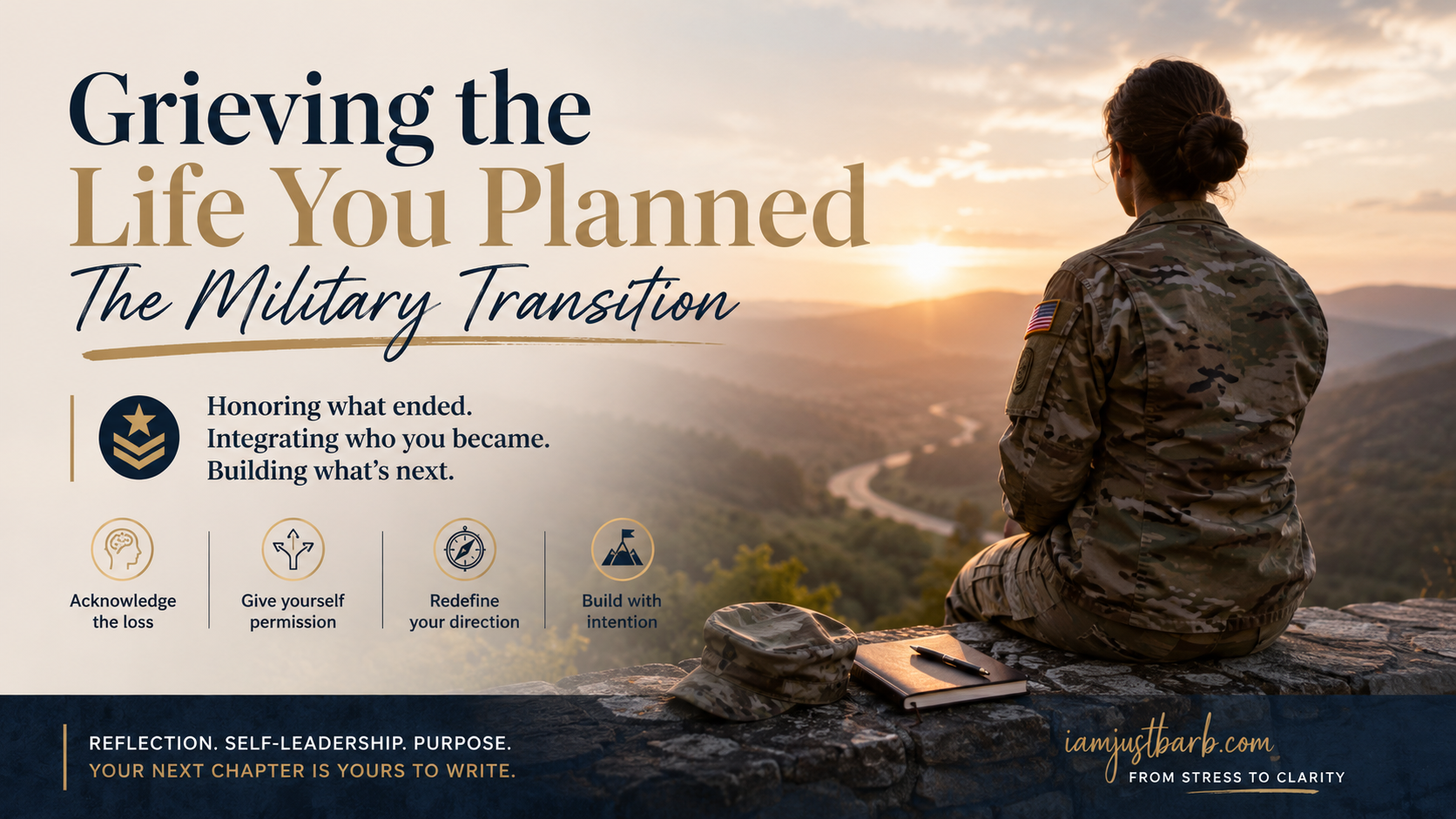
It’s about redefining purpose, identity, belonging, and direction.
🧭 Micro-Exercise: Carry, Release, Build
Take 3–5 minutes today.
Grab a piece of paper and create three columns:
1. CARRY FORWARD
What did the military teach me that still serves me?
Examples:
• Discipline
• Leadership
• Accountability
• Teamwork
• Resilience
2. RELEASE
What expectations, identities, or beliefs am I ready to stop carrying?
Examples:
• “I always have to be strong.”
• “My worth comes from my productivity.”
• “I should already have everything figured out.”
3. BUILD
What do I want to intentionally create in this next chapter?
Examples:
• A new definition of success
• Healthier relationships
• A meaningful career
• More flexibility
• A renewed sense of purpose
Then pause.
Take one slow breath.
Look at your three columns and ask:
“What is one small action I can take this week toward the life I want to build?”
You don’t have to rebuild your entire life today.
One intentional step is enough.
If you’re struggling with the life you planned versus the life you’re living now, give yourself permission to grieve the difference.
Then ask yourself:
What do I want to carry forward?
What am I ready to release?
And what am I ready to build next?
Your military chapter may have ended.
Your leadership story hasn’t.
Educational and coaching reflection; not a substitute for professional mental-health care.
#MilitaryTransition #VeteranTransition #VeteranLeadership #VeteranLife #IdentityTransition #SelfLeadership #Purpose #LeadershipDevelopment #FromStressToClarity
Until next time, take care and keep shining! 👋🏽✌🏽🐝
Yes, I use AI.
I believe in using the technology and tools available to me to support my creativity, organize ideas, explore possibilities, and bring concepts to life. AI is one of the tools in my toolbox—not a replacement for my experience, perspective, or voice.
Technology continues to evolve. So do we.