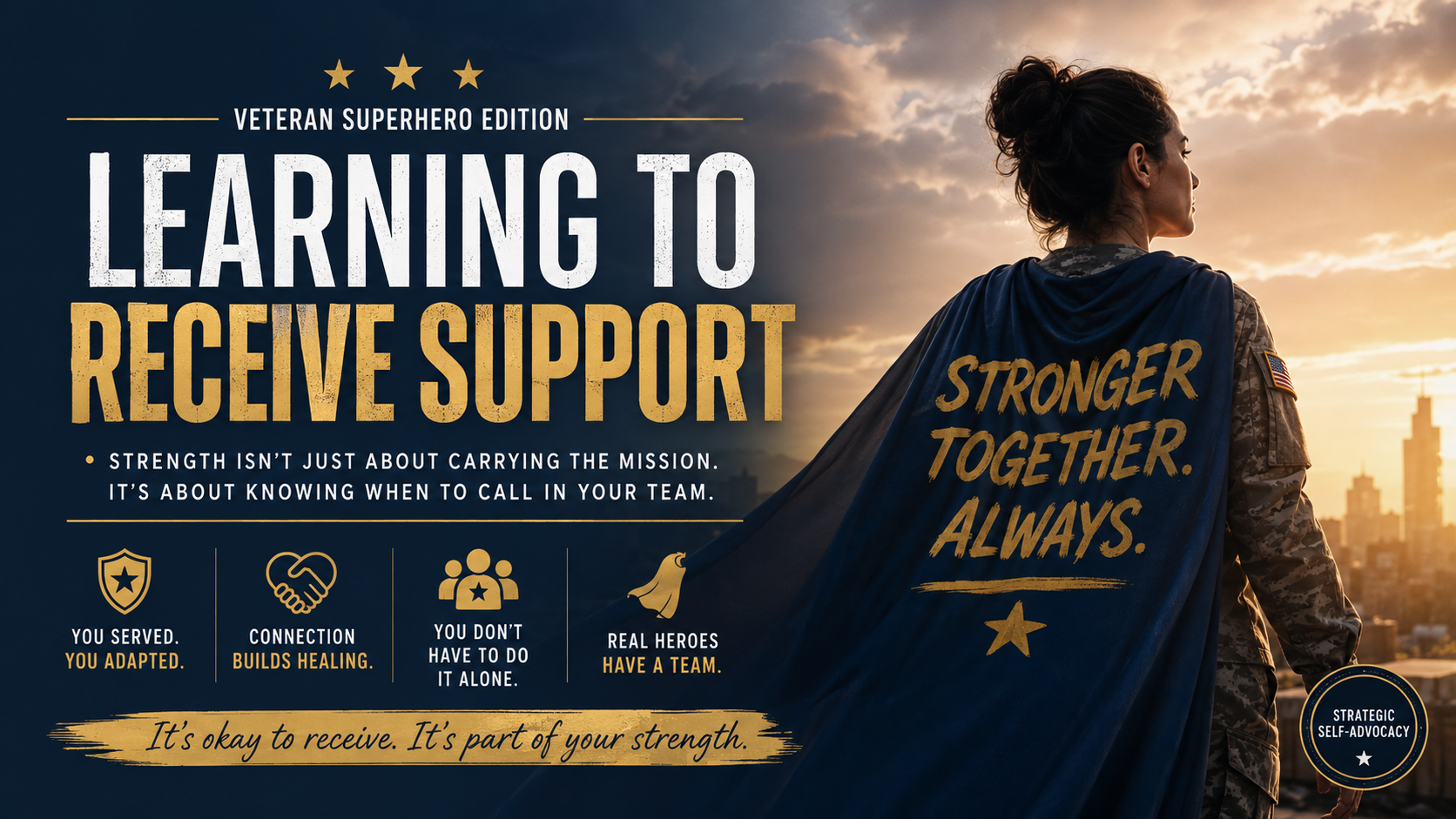

Transitioning from Guard or Reserve service into veteran status can feel different from what many people expect.
For some, there is a clear moment when active service ends. For others, the transition can happen gradually. You may still be working a civilian job, caring for your family, building a career, or figuring out what comes next while simultaneously learning what your military service means in this new chapter of your life.
You may find yourself asking:
“Am I really a veteran?”
“What benefits am I eligible for?”
“Does my service count?”
“What do I do now?”
These questions are not signs that you are behind. They are part of the transition.
Your Service Does Not End When the Uniform Comes Off
Guard and Reserve service can create a unique relationship with military identity.
You may have spent years moving between civilian and military environments—drilling one weekend a month, completing annual training, responding to mobilizations, supporting missions, or transitioning back into civilian employment.
That experience can make the transition to veteran status feel complicated.
You may not immediately identify with the word veteran, especially if your military experience looked different from someone who spent an entire career on active duty.
But your transition deserves to be acknowledged.
Your military experience is part of your professional and personal story.
It may have developed skills such as:
- Leadership
- Adaptability
- Accountability
- Teamwork
- Communication
- Problem-solving
- Mission planning
- Resilience
- Working under pressure
- Operating across different cultures and environments
The challenge is learning how to translate those experiences into language that makes sense in your civilian life.
Understanding Veteran Status
One of the most important steps during transition is learning that veteran status, eligibility for VA benefits, and eligibility for a particular VA program are not always the same question.
Eligibility can depend on factors such as your type of service, dates of service, character of discharge, deployment or activation history, and the specific benefit you are seeking.
That is why assumptions can be risky.
Instead of asking only:
“Do I qualify as a veteran?”
consider asking:
“What benefits, services, and resources may I be eligible for based on my specific military service?”
The U.S. Department of Veterans Affairs provides information about eligibility for VA benefits, including health care, disability compensation, education, home loans, life insurance, and other programs.
You can begin with the official U.S. Department of Veterans Affairs resources: VA.gov.
You can also review your military records and service history through VA.gov records and benefits resources.
Don’t Leave Your Service Story in the Past
One of the biggest mistakes during transition is thinking:
“My military experience is over, so it doesn’t matter anymore.”
It matters.
Your service can become part of the foundation for what you build next.
The question is not necessarily:
“How do I recreate my military career?”
The better question may be:
“What did my military experience teach me that I can carry forward?”
Maybe you learned how to lead people.
Maybe you learned how to remain calm when circumstances changed.
Maybe you learned how to communicate with people from different backgrounds.
Maybe you discovered that you are capable of more than you previously believed.
Those lessons can become part of your civilian career, business, leadership style, education, or community service.
Give Yourself Permission to Reintroduce Yourself
Transition is not simply about finding another job.
It can also be about redefining yourself.
You may have spent years being known by your military occupational specialty, rank, unit, responsibilities, or mission.
Now you may need to answer a different question:
Who am I outside of that role?
You don’t have to abandon your military identity.
You can expand it.
You can be a veteran, a professional, a parent, an entrepreneur, a student, a leader, a mentor, an artist, a business owner, or whatever else represents the person you are becoming.
Your next chapter does not erase the previous one.
It builds on it.
Micro-Exercise: The Service-to-Strength Bridge
Take five minutes and create three columns.
1. What I Did
Write down one responsibility or experience from your Guard or Reserve service.
Example:
“I coordinated a team during annual training.”
2. What I Learned
Identify the skill behind that experience.
Example:
“I learned how to communicate expectations and coordinate people under time constraints.”
3. How I Can Use It Now
Connect that skill to your current or future life.
Example:
“I can use that leadership and communication experience in project management, supervision, community work, or entrepreneurship.”
Then complete this sentence:
“My military service taught me ________, and I can use that strength today by ________.”
Read your answer aloud.
You are not simply looking backward.
You are translating your experience forward.
A Practical Transition Checklist
If you are moving from Guard or Reserve service into veteran status, consider taking these steps:
1. Gather your records.
Keep copies of your DD214 and other relevant military records, orders, medical documentation, awards, and service records.
2. Learn your potential VA eligibility.
Don’t rely on assumptions or someone else’s service history. Eligibility can be individual and benefit-specific.
3. Review your VA health-care options.
Explore eligibility and enrollment through VA health care.
4. Explore education and career resources.
The U.S. Department of Labor provides veteran employment resources through its Veterans’ Employment and Training Service (VETS): DOL Veterans’ Employment and Training Service.
5. Explore state resources.
Every state has resources for veterans. Your state Department of Veterans Services or equivalent agency can help you understand available programs and connect you with accredited assistance.
6. Don’t navigate benefits alone.
A VA-accredited Veterans Service Officer (VSO), attorney, or claims agent may be able to help you understand and navigate VA claims and benefits.
You can find accredited representatives through the VA’s official search tool: Find a VA-accredited representative.
Your Transition Is a Chapter, Not a Verdict
There may be moments when you feel like you are between identities.
Not quite who you were.
Not yet sure who you are becoming.
That space can be uncomfortable.
But it can also be an opportunity.
Your Guard or Reserve service gave you experiences, relationships, skills, responsibilities, and lessons. You don’t have to minimize them simply because your service looked different from someone else’s.
You also don’t have to prove that your transition is difficult enough to deserve support.
You are allowed to ask questions.
You are allowed to learn.
You are allowed to ask for help.
And you are allowed to build something new.
Your military service is part of your story. It does not have to be the end of your story.
Reflection Question
What part of your military experience are you ready to carry forward—not because you have to, but because it still represents something valuable about who you are?
Take that answer with you into your next chapter.
Until next time, take care and keep shining! 👋🏽✌🏽🐝
Yes, I use AI.
I believe in using the technology and tools available to me to support my creativity, organize ideas, explore possibilities, and bring concepts to life. AI is one of the tools in my toolbox—not a replacement for my experience, perspective, or voice.
Technology continues to evolve. So do we.