
Entrepreneurship starts with an idea.
But having an idea is only the beginning.
The challenge is figuring out what to do with it.
Should you turn it into a product? A service? A business? A new offer? A content strategy? A personal brand?
Sometimes you don’t need another brainstorming session.
You need a simple way to organize what you’re already thinking.
That’s where templates can help.
A good template isn’t meant to tell you what your business should be. It gives you questions, structure, and space to think through your own ideas.
Here are a few micro-exercises you can use when you’re trying to develop your next business idea.
1. The “What Problem?” Exercise
Take one idea you’re considering and complete this sentence:
“I want to help ______ solve ______.”
Don’t worry about making it sound like a business statement yet.
Just identify the problem.
Then ask:
- Who experiences this problem?
- Why does it matter?
- How are they solving it now?
- What could I do differently?
This exercise can help move an idea from “This would be cool” to “This could be useful.”
That’s an important shift for an entrepreneur.
2. The “10 Possibilities” Exercise
Give yourself five minutes.
Write down 10 different ways you could turn one skill, experience, or idea into an offer.
For example:
One skill →
- Coaching
- Consulting
- Workshop
- Course
- Workbook
- Template
- Speaking engagement
- Membership
- Service package
- Digital product
Don’t evaluate the ideas while you’re creating them.
The goal is to expand your possibilities before deciding which direction makes sense.
3. The “Who Is This For?” Exercise
Entrepreneurs can become so excited about an idea that they forget to ask an important question:
Who actually needs it?
Write down three possible audiences.
Then ask:
What does each audience need from me?
You may discover that the same idea could serve different people in completely different ways.
Your next step isn’t necessarily to choose immediately.
It’s to understand the possibilities.
4. Put the Idea on Paper
This is where a business plan template becomes useful.
Instead of keeping your business idea in your head, start giving it structure.
Use a template to work through areas such as:
- Business concept
- Mission and vision
- Target audience
- Products or services
- Market
- Competition
- Marketing
- Operations
- Financial considerations
- Goals and next steps
You may not have every answer.
That’s okay.
The template isn’t there because you already know everything.
It’s there to help you identify what you know, what you don’t know, and what you need to explore next.
5. Turn One Idea Into One Action
Choose the idea that keeps coming back to you.
Then ask:
“What is one thing I can do this week to explore it?”
Not launch.
Not perfect.
Explore.
You might:
- Talk to a potential customer.
- Research your market.
- Outline your service.
- Create a simple offer.
- Draft a business plan.
- Build a budget.
- Create a content idea.
- Test a landing page.
The goal is movement.
Templates Are More Than Blank Forms
A template can be a thinking tool.
It can help you slow down long enough to ask better questions, organize your thoughts, and see connections you may have missed.
For an entrepreneur, that structure can be especially valuable when you’re moving between ideas, decisions, and action.
You don’t need to have the entire business figured out today.
Start by putting the idea somewhere you can work with it.
Write it down. Explore it. Structure it. Test it.
Then let the next step become clearer.
Start With a Framework
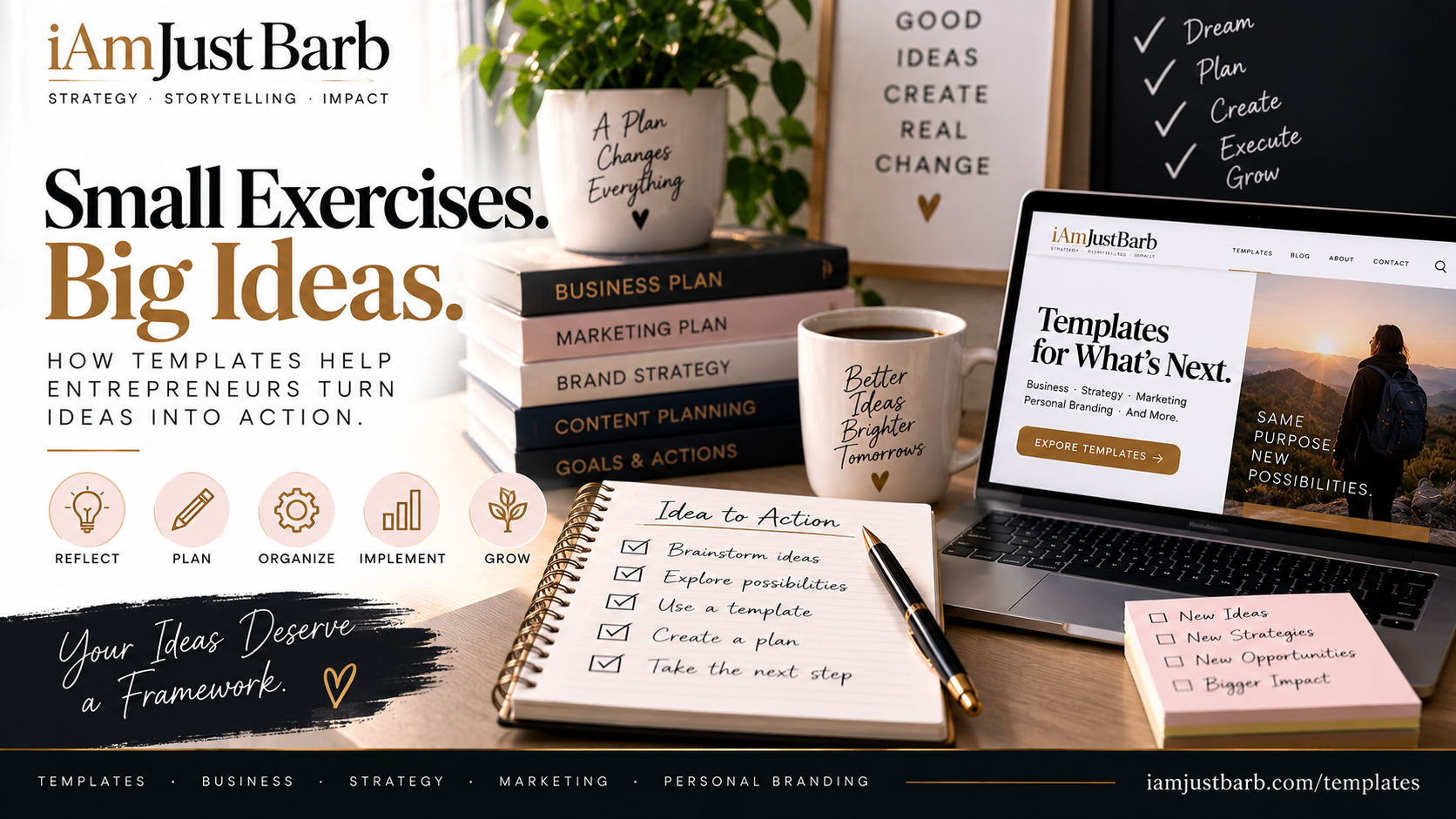
The iAmJustBarb Templates are designed for entrepreneurs, aspiring business owners, coaches, consultants, freelancers, creatives, and professionals who are ready to turn ideas into intentional action.
Explore the templates for business planning, strategy, marketing, personal branding, and more:
Your idea deserves more than a blank page.
Give it a framework.
Until next time, take care and keep shining! 👋🏽✌🏽🐝
Yes, I use AI.
I believe in using the technology and tools available to me to support my creativity, organize ideas, explore possibilities, and bring concepts to life. AI is one of the tools in my toolbox—not a replacement for my experience, perspective, or voice.
Technology continues to evolve. So do we.