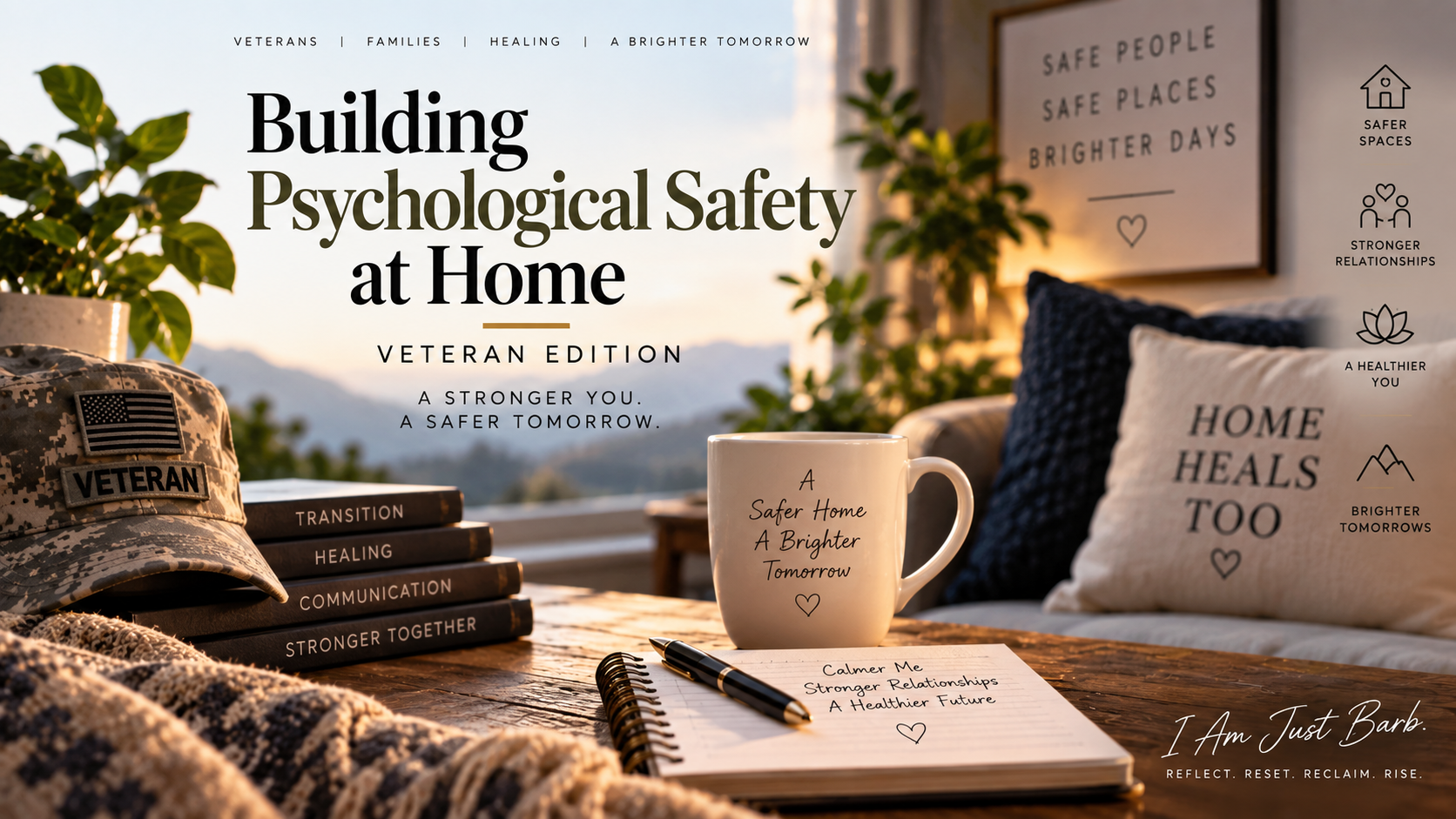

A Veteran Reflection
For many Veterans, home is supposed to be where the mission ends.
But sometimes, the body doesn’t get the message.
You may have spent years learning to stay alert, respond quickly, read the room, control your emotions, and keep moving regardless of what was happening around you.
Those skills may have helped you survive.
But at home, they can sometimes make it difficult to simply feel safe.
Psychological safety at home isn’t about creating a perfect environment.
It’s about creating a space where you don’t always have to be on guard.
Where you can say, “I’m having a hard day,” without feeling like you have failed.
Where silence doesn’t automatically mean something is wrong.
Where asking for space isn’t rejection.
Where taking a moment to regulate isn’t weakness.
And where the people you love understand that transitioning from military life can involve learning a different way of responding—not just to the world, but to yourself.
Sometimes the first step is noticing.
Ask yourself:
Do I feel like I can truly relax at home?
Can I communicate what I need before I reach my breaking point?
Do I allow myself to have difficult emotions without judging them?
Have I explained to the people I love what helps me feel safe and supported?
Building psychological safety begins with small moments of awareness.
You don’t have to change everything at once.
Sometimes it begins with lowering your voice.
Taking a breath.
Stepping away before reacting.
Saying, “I need a few minutes.”
Or simply admitting:
“I’m still learning how to feel safe after everything I’ve experienced.”
Home can become more than the place where you sleep.
It can become a place where you unlearn survival mode and practice being present.
That is part of the transition, too.
Reflect. Reset. Reclaim. Rise.
— Barbara
A Note of Care
This reflection is for educational and personal-reflection purposes. It is not medical, psychological, or mental-health treatment advice and does not replace evaluation or care from a qualified professional. Every Veteran’s transition and experience is different. If stress, trauma-related experiences, conflict, or difficulty feeling safe are significantly affecting your daily life or relationships, consider speaking with a qualified mental-health professional or an appropriate Veteran support resource.
Micro-Exercise: The 60-Second Safety Check
Before reacting to a difficult moment at home, pause for about one minute.
1. Notice:
What am I feeling right now?
2. Breathe:
Take three slow, comfortable breaths. Don’t force your breathing—just give yourself a moment to slow down.
3. Look around:
Name three things you can see and notice where you are right now.
4. Ask:
“Am I responding to what is happening right now, or am I reacting to what my body has learned to expect?”
5. Choose:
Instead of immediately reacting, choose one intentional response:
“I need a few minutes.”
“Let’s talk about this when I’m calmer.”
“I hear you. I just need a moment.”
This isn’t about suppressing your emotions or pretending everything is okay.
It’s about creating a small space between feeling and reacting.
Research involving Veterans suggests that mindfulness-based approaches may help reduce psychological symptoms and improve quality of life, although the evidence varies and these practices should not be treated as a replacement for evidence-based mental-health care.
The VA’s National Center for PTSD also describes Veteran-focused approaches that incorporate emotion regulation, communication, and time-outs during conflict—skills that can support healthier interactions at home.
A Question to Carry With You
The next time you notice yourself becoming tense at home, don’t immediately ask:
“What’s wrong with me?”
Try asking:
“What is my body trying to protect me from—and is that danger actually here right now?”
Sometimes awareness is the first step toward creating a different response.
Reflect. Reset. Reclaim. Rise.
— Barbara
Research note: This exercise is a simple self-reflection practice inspired by mindfulness and emotion-regulation approaches. It is not a clinical intervention or substitute for professional care. If grounding or mindfulness exercises increase distress, stop the exercise and consider discussing it with a qualified mental-health professional.
Explore more reflections and self-nurturing resources at:
Explore more reflections, self-nurturing resources, and strategic self-advocacy content at:
iAmJustBarb.com
Self-Nurturing • Strategic Self-Advocacy • Communication • Leadership
Until next time, take care and keep shining! 👋🏽✌🏽🐝
Yes, I use AI.
I believe in using the technology and tools available to me to support my creativity, organize ideas, explore possibilities, and bring concepts to life. AI is one of the tools in my toolbox—not a replacement for my experience, perspective, or voice.
Technology continues to evolve. So do we.