
There is a lesson many veterans learn the hard way:
Being strong does not mean doing everything alone.
You learned to carry the mission.
Carry the gear.
Carry the responsibility.
Carry your battle buddy.
Keep moving when you were tired.
Stay focused when things were uncomfortable.
You became the person others could count on.
But what happens when you are the one who needs someone?
The Veteran Superpower We Don’t Talk About
Receiving support can feel strangely uncomfortable after military service.
You may think:
“I should be able to handle this.”
“Someone else has it worse.”
“I don’t want to be a burden.”
“I’ll figure it out myself.”
“I don’t need help.”
But accepting support isn’t surrender.
It is another form of strength.
Research involving 4,069 U.S. veterans found that social support was meaningfully associated with mental health. The study also found that veterans who both provided and received support had substantially lower odds of several adverse mental-health outcomes compared with veterans who had high received support but low provided support.
The research suggests that social support is not simply about having people around you. Both giving and receiving support can be meaningful parts of a veteran’s social and emotional well-being. (Nature)
Research examining social connection among veterans diagnosed with PTSD also identified several important themes, including peer support, social reintegration, trust, community, purpose, group connection, and empowerment. These factors may help address social isolation and loneliness. (PubMed)
So maybe the superhero lesson isn’t:
“I don’t need anyone.”
Maybe it’s:
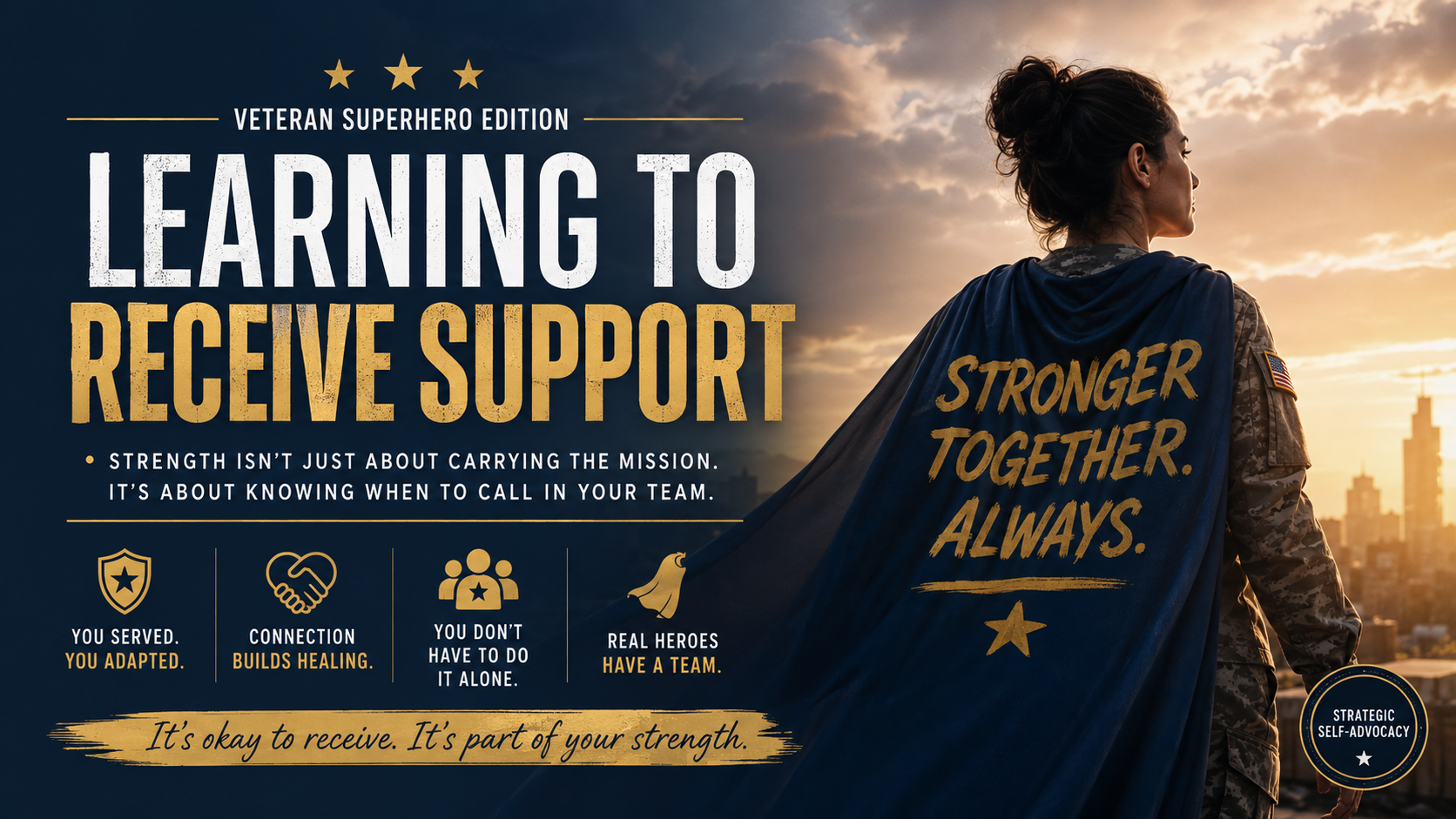
“I know when to call in my team.”
Strength Has Two Directions
We often celebrate the veteran who shows up for everyone else.
The mentor.
The leader.
The protector.
The friend who answers the phone.
The person everyone calls when something goes wrong.
But healthy connection has two directions:
Giving support.
Receiving support.
You deserve to experience both.
Research by Na and colleagues found that providing social support was independently associated with lower odds of several internalizing psychiatric disorders and suicidal ideation among veterans. The study also found that veterans reporting both high levels of received and provided support had substantially lower odds of several adverse outcomes. (Nature)
That means your role doesn’t have to change from strong to weak.
It can change from:
“I have to carry everything.”
to:
“I don’t have to carry everything by myself.”
The Superhero Doesn’t Fight Every Battle Alone
Think about your favorite superhero.
They have a team.
Batman has the Bat-Family.
The Avengers have the Avengers.
The Justice League has the League.
Even superheroes have people they trust.
So why should your healing require you to operate like a one-person unit?
Sometimes your support team might include:
- A fellow veteran who understands without an explanation.
- A trusted friend or family member.
- A mentor.
- A faith community.
- A therapist or counselor.
- A veteran organization.
- A professional who understands military culture.
- Someone who simply knows how to sit with you without trying to fix everything.
A systematic review of interventions involving veterans with PTSD found that peer support, social reintegration, group cohesiveness, building trust, purpose, community, and empowerment were recurring themes in approaches addressing social isolation and loneliness. (PubMed)
This matters because healing isn’t always about becoming more independent.
Sometimes healing involves learning how to reconnect.
A New Definition of Self-Reliance
Self-reliance doesn’t have to mean:
“I do everything alone.”
It can mean:
“I know what I need, I know who I can trust, and I have the courage to reach out.”
That’s strategic self-advocacy.
That’s self-leadership.
That’s growth.
And sometimes the most courageous sentence isn’t:
“I’ve got this.”
It’s:
“I could use some support right now.”
Micro-Exercise: Call in Your Team
Take two minutes today.
Identify three people or resources you could reach out to when life feels heavy.
Then complete these sentences:
- When I’m struggling, I usually: ______________________________
- The person I feel safest reaching out to is: ______________________________
- One thing I could allow someone to help me with is: ______________________________
- Instead of saying “I’m fine,” I could honestly say: ______________________________
Don’t overthink the answers.
The goal isn’t to create a perfect support system.
The goal is to begin recognizing that you don’t have to be the only resource available to yourself.
You Don’t Lose Your Superhero Status
You don’t lose your superhero status because you needed a teammate.
You don’t become less capable because you accepted help.
You don’t become less resilient because someone stood beside you.
Sometimes the superhero’s greatest power is knowing when not to fight alone.
Reflection
What if receiving support isn’t evidence that you’re failing at being strong?
What if it is evidence that you’re learning how to live beyond survival?
You served.
You adapted.
You survived.
Now you can learn something new:
How to receive.
How to trust.
How to connect.
How to let someone stand beside you.
Because even superheroes deserve a team.
A Final Thought
Military service can teach us extraordinary lessons about responsibility, teamwork, sacrifice, and resilience.
But there can be another lesson after service:
You are allowed to be supported, too.
You don’t always have to be the strong one.
You don’t always have to have the answer.
You don’t always have to carry the weight.
Sometimes strength looks like reaching out.
Sometimes courage looks like saying, “I need help.”
And sometimes healing begins when you finally give someone permission to stand beside you.
You were never meant to fight every battle alone.
Important Note
This reflection is educational and coaching-oriented. It is not a substitute for mental-health treatment, diagnosis, or professional clinical care. If you are experiencing significant emotional distress or are concerned about your safety, consider reaching out to an appropriate mental-health professional or crisis-support resource.
Research References
Na, P. J., Tsai, J., Southwick, S. M., & Pietrzak, R. H. (2022). Provision of social support and mental health in U.S. military veterans. npj Mental Health Research, 1, Article 4. The study analyzed a nationally representative sample of 4,069 U.S. veterans and examined the relationship between providing and receiving social support and mental-health outcomes. (Nature)
Gettings, R. D., Kirtley, J., Wilson-Menzfeld, G., Oxburgh, G. E., Farrell, D., & Kiernan, M. D. (2022). Exploring the Role of Social Connection in Interventions With Military Veterans Diagnosed With Post-traumatic Stress Disorder: Systematic Narrative Review. Frontiers in Psychology, 13, 873885. The review examined 28 studies and identified themes including peer support, social reintegration, purpose, community, group cohesiveness, empowerment, and building trust. (PubMed)
Rakesh, G., Clausen, A. N., Buckley, M. N., Clarke-Rubright, E., Fairbank, J. A., Wagner, H. R., Morey, R. A., et al. (2022). The role of trauma, social support, and demography on veteran resilience. European Journal of Psychotraumatology, 13(1), 2058267. The study examined resilience, trauma, PTSD severity, and social support in a sample of 3,876 U.S. military veterans. (doi.org)