

Sometimes, the most productive thing you can do is pause, acknowledge what you feel, and give yourself the attention you need.
We live in a world that encourages us to keep moving. We answer messages, meet deadlines, support others, manage responsibilities, and make decisions. Even when we feel overwhelmed, we may convince ourselves that we simply need to push harder.
But what happens when pushing through becomes our only response to stress?
Sometimes, we need a different approach. Instead of ignoring our emotions or judging ourselves for having them, we can learn to acknowledge what is happening within us and respond with greater awareness.
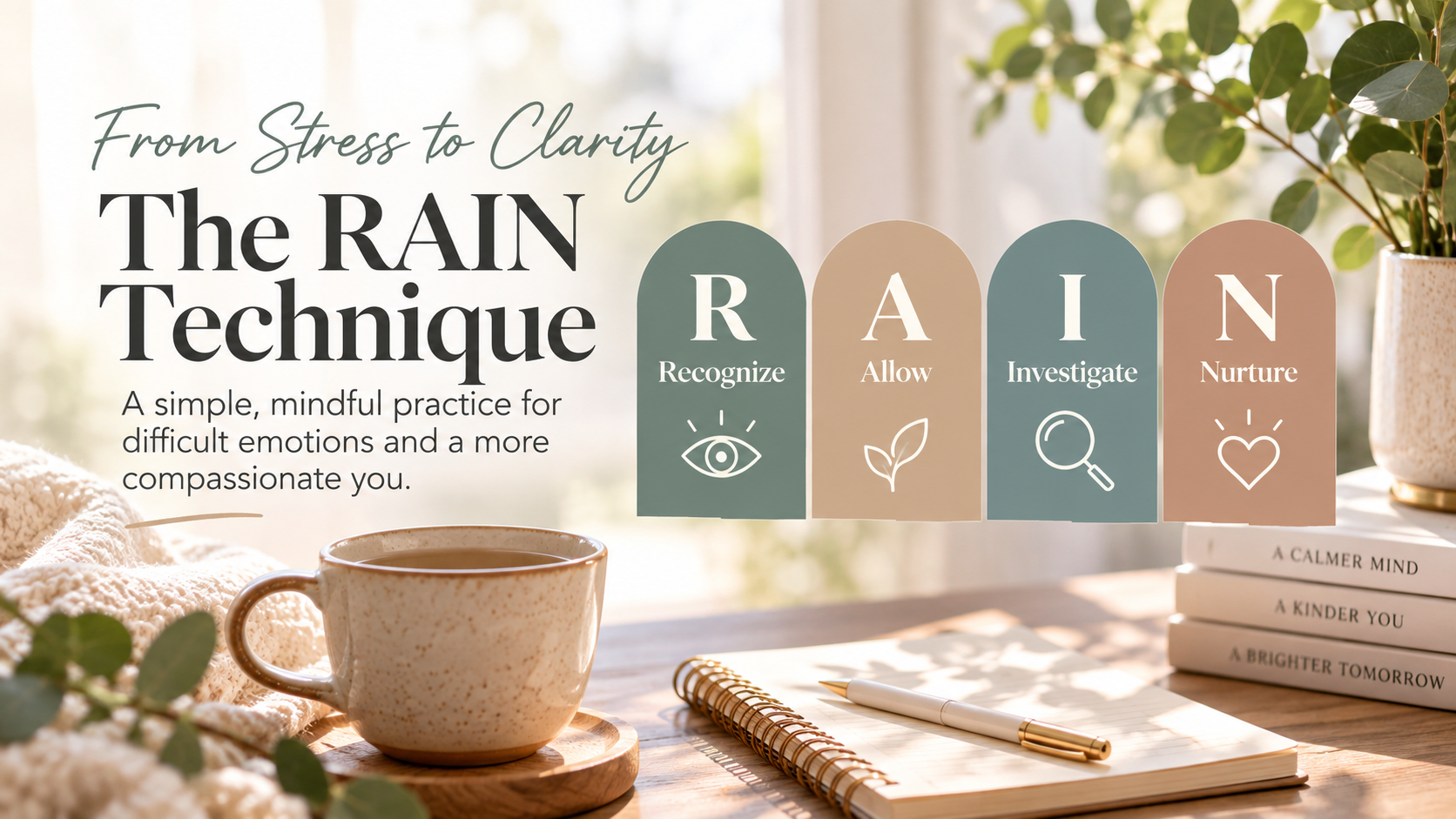
One mindfulness-based approach that can help us practice this is the RAIN technique: Recognize, Allow, Investigate, and Nurture.
RAIN offers a simple framework for working with difficult emotions and anxiety. It encourages us to pause, observe our experience, explore what we need, and respond with compassion rather than criticism.
In my From Stress to Clarity approach, this is an opportunity to practice self-nurturing: making space to understand yourself before deciding what to do next.
What Is the RAIN Technique?
RAIN is a four-step mindfulness practice that can help you approach difficult emotions with greater awareness and self-compassion.
Each letter represents an intentional step:
- R — Recognize: Notice what you are experiencing.
- A — Allow: Give yourself permission to acknowledge the experience without immediately trying to suppress it.
- I — Investigate: Explore what you are feeling with curiosity rather than judgment.
- N — Nurture: Respond to yourself with kindness and compassion.
You do not need to wait until you reach a breaking point to use this practice. You can try it during a stressful workday, after a difficult conversation, when facing an uncertain decision, or whenever you notice that your emotions are demanding your attention.
Let’s explore each step.
1. Recognize: Notice What Is Happening
The first step is to pause and identify what you are experiencing.
You might notice frustration after a conversation, anxiety before a presentation, disappointment about an unexpected outcome, or tension when you have too many responsibilities.
Instead of immediately reacting, take a moment to acknowledge what is happening.
Ask yourself:
- What am I feeling right now?
- What thoughts are occupying my attention?
- What sensations am I noticing in my body?
- What happened just before I began feeling this way?
Try to describe your experience without criticizing yourself.
For example, instead of saying, “I shouldn’t feel this way,” try saying, “I notice that I am feeling overwhelmed.”
The difference is important. You are acknowledging your experience rather than adding another layer of judgment to it.
Daily task: Take one minute to name the emotion you are experiencing. You do not have to solve it or explain it immediately. Start by noticing.
2. Allow: Accept the Experience
Once you recognize what you are feeling, the next step is to allow yourself to acknowledge it.
Allowing does not mean that you approve of everything that happened. It does not mean that you must remain in an uncomfortable situation, agree with someone, or abandon your boundaries.
It means giving yourself permission to recognize your emotional experience without immediately fighting against it.
Sometimes, we use so much energy trying not to feel something that we have little energy left to understand what is happening.
We tell ourselves to stop worrying, stop feeling disappointed, or get over an experience before we have even acknowledged its impact.
Instead, try saying:
“I am allowed to acknowledge what I am feeling.”
You can accept that an emotion is present without letting that emotion dictate your next action.
If the feeling becomes too intense, you can pause the exercise, orient yourself to your surroundings, and seek support if needed. You do not have to force yourself to remain with an overwhelming experience.
Daily task: When you notice an uncomfortable emotion, take a gentle pause. If it feels comfortable, breathe naturally and remind yourself that you do not have to resolve everything in this moment.
3. Investigate: Explore with Curiosity
The third step invites you to explore your experience with curiosity instead of judgment.
This is not about overanalyzing every thought or searching for something to blame. It is about giving yourself an opportunity to understand what may be contributing to your feelings and what kind of support you might need.
Consider asking yourself:
- What might be contributing to this feeling?
- Is there an unmet need I should pay attention to?
- Am I responding to what is happening now, something that happened earlier, or both?
- Is there a boundary, conversation, or responsibility I need to address?
- What would help me feel more supported in this moment?
You may discover that what initially appeared to be frustration is connected to exhaustion, uncertainty, disappointment, or a need for clearer communication.
You may also discover that you do not yet have an answer. That is okay.
Self-awareness is not about finding an immediate explanation for every emotion. Sometimes, the most useful discovery is recognizing that you need more time, rest, information, or support.
Daily task: Write down one question about what you are feeling. Give yourself a few minutes to reflect without demanding an immediate answer.
4. Nurture: Offer Yourself Compassion
The final step is to respond to yourself with kindness.
Think about how you would speak to someone you care about who was experiencing a difficult day. Would you tell them that they are weak for feeling overwhelmed? Would you demand that they resolve everything immediately?
Or would you listen, acknowledge their experience, and help them consider what they need?
Self-nurturing invites you to extend that same consideration to yourself.
You might say:
- “I can take this one step at a time.”
- “I do not have to be perfect to make progress.”
- “My feelings deserve attention, even when I do not fully understand them.”
- “It is okay to ask for help.”
- “I can respond thoughtfully instead of reacting immediately.”
Compassion can also involve taking a practical action. You might step away from your desk briefly, drink some water, clarify a confusing expectation, postpone a nonurgent decision, or reach out to someone you trust.
The important question is not simply, “How can I stop feeling this way?”
It is also, “How can I take care of myself while I work through this?”
Daily task: Choose one small, realistic action that supports your well-being. Make it something you can actually do today.
Your Daily RAIN Practice: A Five-Minute Check-In
You can use the following exercise as a daily reflection, either in the morning, during a break, or at the end of your day.
Minute 1 — Recognize
Name what you are experiencing. What emotion, thought, or physical sensation has your attention?
Minute 2 — Allow
Acknowledge the experience without immediately criticizing yourself or demanding that it disappear.
Minutes 3 and 4 — Investigate
Ask what might be contributing to the feeling and what you may need. Write down any observations that feel useful.
Minute 5 — Nurture
Choose one compassionate statement and one practical next step.
Your response does not have to be dramatic. Sometimes, the next step is to rest. Sometimes, it is to communicate more clearly. Sometimes, it is to ask for assistance or recognize that a situation is beyond your immediate control.
The purpose is to make your next action more intentional.
Remember: five minutes is a suggested practice duration, not a scientifically established requirement for the RAIN technique.
How RAIN Supports Self-Nurturing
Self-nurturing is not limited to taking a day off, enjoying a hobby, or creating a relaxing environment. It also involves how we respond to our internal experiences.
When we repeatedly dismiss our feelings, we may miss opportunities to recognize our needs, communicate boundaries, or make thoughtful decisions.
RAIN offers a structured way to slow down and pay attention.
Recognizing helps us notice. Allowing creates room for the experience. Investigating encourages understanding. Nurturing helps us consider a compassionate response.
These steps do not guarantee that difficult emotions will disappear. They provide a way to approach those emotions with greater awareness and care.
You can also adapt the practice to your circumstances. If a situation feels unsafe or overwhelming, prioritize your immediate safety and seek appropriate support rather than forcing yourself to work through it alone.
And remember: practicing self-compassion does not mean avoiding accountability. You can acknowledge your feelings, recognize the impact of your actions, learn from an experience, and make a different choice next time.
Growth and compassion can coexist.
Reflection: What Do You Need Today?
Before moving on to your next responsibility, take a moment to consider these questions:
- What emotion have I been ignoring or minimizing?
- What might this feeling be telling me about my current needs?
- What can I do today to respond to myself with greater compassion?
- What is one thing I can address now, and what can wait?
You do not need to answer every question perfectly. The purpose is to create space for an honest check-in with yourself.
If writing helps you process your thoughts, keep a small journal and revisit your answers over time. You may begin to notice patterns in the situations that overwhelm you, the needs that frequently go unmet, and the actions that help you feel more grounded.
Awareness can become the starting point for more intentional choices.
From Stress to Clarity: Your Next Step
You cannot always control what happens around you. You may not be able to change a deadline, prevent every difficult conversation, or resolve every uncertainty in a single day.
But you can practice becoming more aware of what is happening within you and more intentional about how you respond.
The RAIN technique offers one way to begin.
Recognize what you feel. Allow yourself to acknowledge it. Investigate with curiosity. Nurture yourself with compassion.
You do not have to wait until everything is resolved to begin caring for yourself.
Sometimes, clarity starts with a pause.
Your daily challenge: Before the day ends, take five minutes to practice RAIN. Write down one thing you noticed about yourself and one action you will take to support your well-being.
Small, intentional practices can help you build a more thoughtful relationship with yourself, one moment at a time.
This article is for educational and general wellness purposes. RAIN is a mindfulness practice, not a substitute for professional mental health care. If emotional distress persists or interferes with daily life, consider speaking with a qualified mental health professional.
Continue your journey with iamjustbarb
Explore more reflections and practical resources on self-nurturing, communication, leadership, and moving from stress to clarity at iamjustbarb.com.
Take a moment. Listen to yourself. Choose your next step with intention.